Hard Start Kits vs. Soft Starters for Aging AC Compressors

Why Do the Lights Dim When Your Older AC Turns On?
Have you ever noticed the lights in your home flicker or dim right as your air conditioner kicks on? When trying to resolve this unsettling power draw, many homeowners find themselves weighing hard start kits vs. soft starters for aging AC compressors. That brief moment of darkness is more than just a minor electrical quirk; it is a visible symptom of a mechanical system struggling to initiate its cooling cycle. As equipment ages, the internal components require significantly more energy to overcome physical resistance and get the motor spinning.
This hesitation is especially common during the August late-summer cooling season, when systems have already endured months of heavy usage. The compressor is the heart of your cooling system, and when it struggles to start, it places immense stress on your home's electrical panel and the unit's internal wiring. Identifying the root cause of this hesitation is the first step toward finding a safe, effective solution. If you are experiencing these warning signs, reaching out to our team at Thompson's Heating & Air for professional AC repair services can help you determine the right path forward to protect your equipment.
The Late-Summer Strain on Split-System Equipment
By the time late summer arrives, cooling equipment has typically accumulated hundreds of hours of continuous operation. This relentless cycle takes a physical and thermal toll on the machinery, increasing the likelihood of startup hesitation.
The Accumulation of Run-Hours
Throughout the spring and early summer, your air conditioner cycles on and off thousands of times. For aging residential split-system compressors, this constant cycling leads to gradual mechanical fatigue. The bearings inside the motor may begin to wear down, and the lubricating oils can degrade over time. By late summer—right around the back-to-school transition—our technicians frequently see that the physical tolerance of these moving parts is significantly reduced, meaning the motor requires far more force to begin its rotation than it did when it was brand new.
The Impact of Extreme Ambient Temperatures
The weather outside plays a massive role in how hard your system has to work before it even turns on. Extreme Sacramento Valley summer temperatures, frequently exceeding 100 degrees, exacerbate thermal wear and increase startup pressure differentials on older HVAC systems. When the unit is sitting idle in the blistering heat, the refrigerant inside the condenser expands, creating exceptionally high head pressures.
When the thermostat calls for cooling, the compressor must immediately push against this massive wall of pressure. It is similar to trying to pedal a bicycle uphill in the highest gear from a complete standstill. The physical strain is immense. Just last August, our Thompson's Heating & Air dispatch team sent an expert to a Woodland homeowner who noticed their air conditioning working poorly just as a severe heat wave was approaching. Our technician arrived on time to diagnose the underlying strain and resolve the problem before the worst of the heat hit, illustrating how quickly high temperatures can expose hidden vulnerabilities in older equipment.
Understanding Inrush Current and Mechanical Inertia
To understand how start aids function, it is helpful to look at the exact electrical and mechanical events that happen in the fraction of a second when your air conditioner turns on.
The Surge of Locked Rotor Amps (LRA)
When an electrical motor is at a complete stop, it acts almost like a short circuit for a brief moment when power is applied. This initial surge of electricity is known as Locked Rotor Amps (LRA). Air conditioning compressors typically require 3 to 6 times their normal running current to start up. This massive gulp of electricity is what causes the lights in your home to dim. Once the motor actually begins spinning, the electrical demand drops rapidly down to its normal operating level, known as Full Load Amps (FLA).
Electrical Demand vs. Mechanical Resistance
In our years of servicing aging residential split-system compressors across Yolo County, we find that the line between an electrical problem and a mechanical problem often blurs during startup.
• Mechanical Inertia: This occurs when the internal parts of the compressor are physically binding. Worn bearings, degraded oil, and high refrigerant head pressures make the motor physically difficult to turn. The motor draws maximum amperage trying to overcome this physical blockade.
• Electrical Load: This refers to the sheer volume of electricity pulled from your home's breaker panel. Even a perfectly healthy compressor draws a large load, but an aging, struggling compressor will pull that maximum load for a longer duration, stressing wires, breakers, and capacitors.
Understanding this distinction is vital because the two different starting aids—hard start kits and soft starters—are designed to solve two entirely different sides of this equation.
Hard Start Kits: Delivering a High-Voltage Jolt
When a compressor is suffering from mechanical inertia and simply cannot overcome the physical resistance to spin, a hard start kit is often the most effective solution we recommend.
The Anatomy of a Hard Start Kit
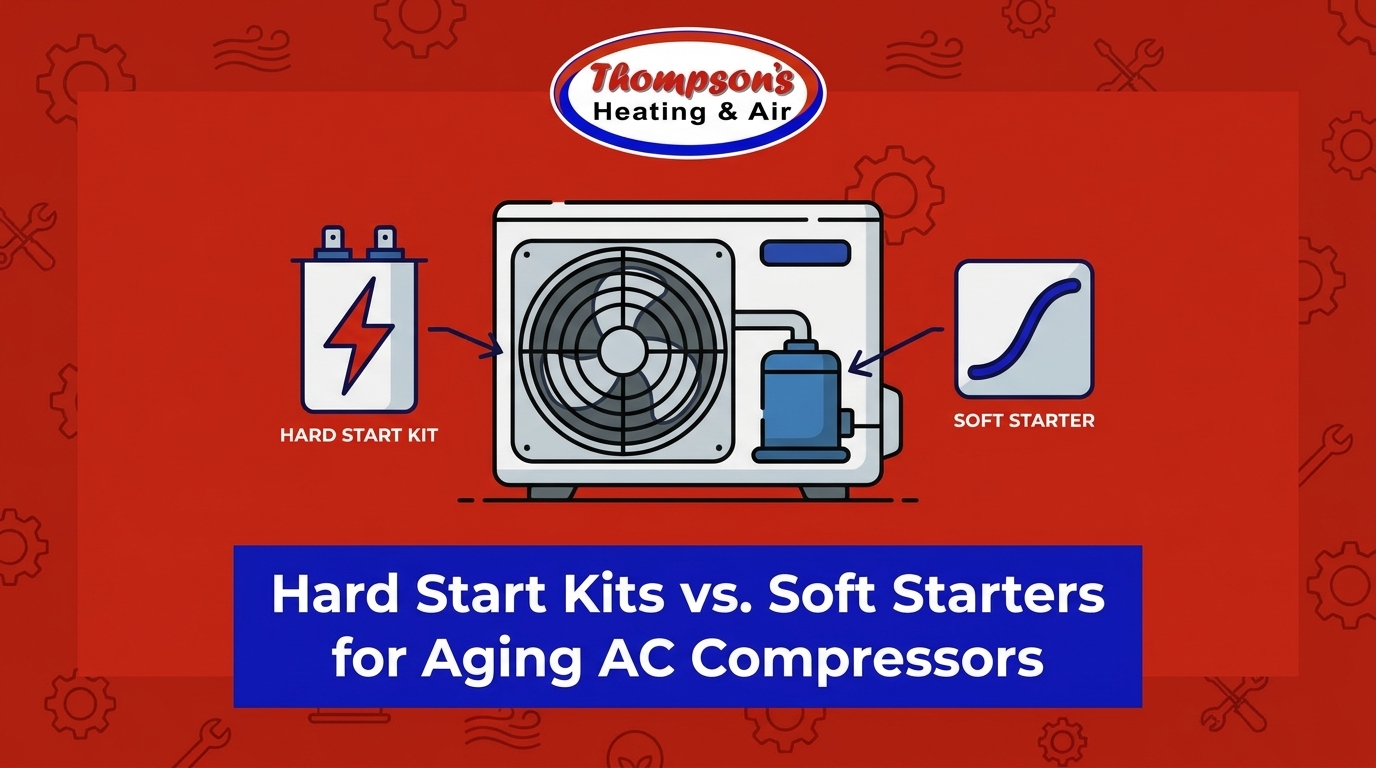
A hard start kit is a relatively simple but highly powerful device. It consists of two primary components: a start capacitor and a potential relay. The start capacitor acts like a highly compressed spring, storing a massive reserve of electrical energy. The potential relay acts as a switch that monitors the motor's speed.
How the Jolt Works
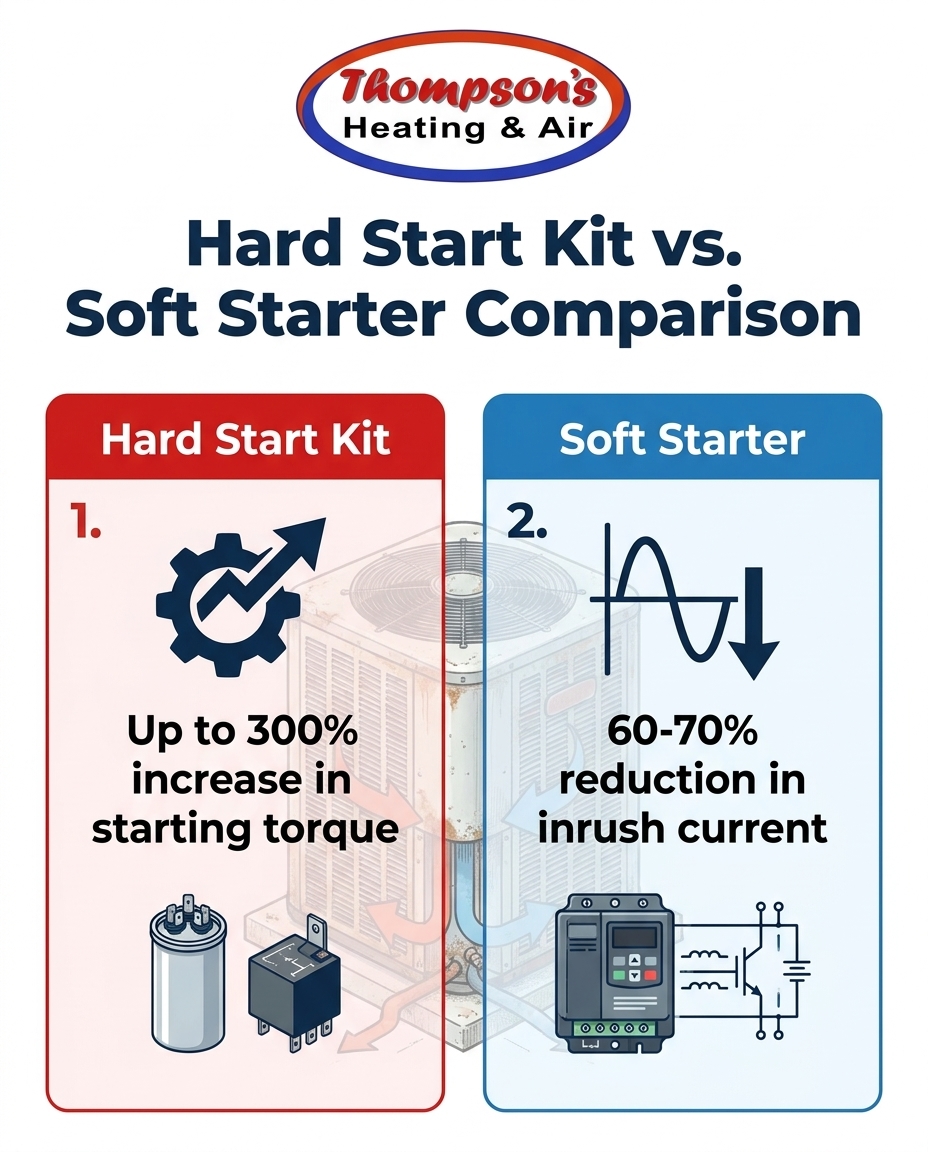
When the thermostat signals the AC to turn on, the hard start kit dumps its stored electrical energy directly into the compressor motor all at once. Hard start kits can increase starting torque by up to 300% to overcome mechanical inertia. This violent, high-voltage jolt essentially forces the stubborn motor to break free from its physical binding and start spinning. Once the motor reaches about 75% of its normal operating speed, the potential relay instantly clicks open, taking the hard start kit out of the electrical circuit so the motor can run normally.
When to Choose a Hard Start Kit
This brute-force method is highly effective for older units that are mechanically tight. During the August late-summer cooling season, when high head pressures are common, our team often utilizes a hard start kit to provide the exact type of physical kick needed to get a struggling compressor moving. However, because it delivers a massive spike of electricity, it does not solve the problem of dimming lights—in fact, it often requires an even larger, albeit shorter, gulp of power from your electrical panel.
Soft Starters: Easing the Electrical Load
While a hard start kit uses brute force to solve a mechanical problem, a soft starter uses advanced electronics to solve an electrical problem.
The Science of Gentle Acceleration
Instead of hitting the compressor motor with 100% of the required voltage instantly, a soft starter acts as an intelligent buffer. It uses solid-state electronics to gently ramp up the electrical current over the span of a few hundred milliseconds. By stepping up the voltage in precise, calculated increments, the soft starter allows the motor to begin turning smoothly without demanding a massive, sudden surge of power from the breaker panel.
Protecting Sensitive Electrical Components
The primary benefit of this technology is a dramatic reduction in electrical demand. Soft starters can reduce inrush current by up to 60-70%, easing the stress on electrical components. This massive reduction means the motor no longer pulls the excessive amperage that causes lights to dim or breakers to trip.
When to Choose a Soft Starter
For aging residential split-system compressors that are still mechanically sound but are pulling too much power on startup, we find a soft starter is ideal. It is also the perfect solution for Woodland homeowners who want to run their air conditioning on a portable backup generator or a home solar battery system. Because these backup power sources cannot handle the massive 3-to-6-times inrush current of a standard AC startup, a soft starter lowers the hurdle, allowing the generator to power the cooling system smoothly.
Side-by-Side Comparison: Which Start Aid Fits Your System?
Choosing the right component depends entirely on whether your system is fighting a mechanical roadblock or an electrical capacity limit. The table below outlines the primary differences between the two technologies.
• Primary Function — Hard Start Kit: Delivers a massive electrical jolt to increase starting torque. — Soft Starter: Uses solid-state electronics to gently ramp up voltage.
• Best For — Hard Start Kit: Overcoming mechanical binding, tight bearings, and high head pressure. — Soft Starter: Protecting sensitive electrical components and reducing power surges.
• Impact on Inrush Current — Hard Start Kit: Often increases the peak amperage draw, but shortens the duration. — Soft Starter: Reduces the peak inrush current by up to 60-70%.
• Impact on Lights Dimming — Hard Start Kit: May not stop lights from dimming (and can sometimes worsen it briefly). — Soft Starter: Effectively eliminates light dimming and voltage drops.
• Generator Compatibility — Hard Start Kit: Not recommended for use with portable backup generators. — Soft Starter: Highly recommended for running AC units on backup generators.
Why High-Voltage Start Aids Require Professional Installation
While the concept of adding a start aid might seem straightforward, integrating these devices into an older HVAC system is highly dangerous and complex. These are not plug-and-play accessories, and attempting to install them without professional training poses severe risks to both the homeowner and the equipment.
The Danger of Stored Voltage
The components involved in starting an air conditioner handle lethal amounts of electricity. Capacitors, in particular, are designed to store massive electrical charges. Even when the main power to the air conditioner is completely shut off at the breaker panel, a capacitor can hold a high-voltage charge for days. Handling these components without the proper discharging tools and safety protocols can result in severe electrical shock.
The Risk of Equipment Destruction
Beyond personal safety, there is a significant risk of permanently destroying the very equipment you are trying to save. If a hard start kit is improperly sized for the specific tonnage of the compressor, or if it is wired incorrectly, it can literally melt the internal windings of the motor. Similarly, a soft starter must be perfectly calibrated to the unit's electrical specifications. Proper diagnosis by a licensed technician from Thompson's Heating & Air is required to know whether the issue is mechanical or electrical before installing any device. Keeping your system on a regular HVAC maintenance plan ensures that a professional is regularly evaluating the electrical health of these high-voltage components, especially during the demanding August late-summer cooling season.
Extending Equipment Life: Repair vs. Full Replacement
The decision to install a start aid is often part of a much larger conversation about the future of your cooling system. When an older unit begins to struggle, many homeowners assume that a complete system overhaul is the only option.
Strategic Bridge Solutions
Start aids function as a strategic, cost-effective bridge solution to gain more years out of existing equipment. At Thompson's Heating & Air, our honest, technical expertise prioritizes these cost-effective solutions to extend equipment life, contrasting with the industry norm of immediately pushing for a full replacement at the first sign of trouble. If the coils are intact, the refrigerant levels are stable, and the only major issue is startup hesitation, adding a start aid can safely keep the unit running for several more seasons.
Real-World Life Extension
A thorough technical evaluation can often save a system that others might write off as dead. In one recent instance, a Thompson's Heating & Air customer believed their 28-year-old system required a full replacement due to its age and performance issues. However, after a thorough technical examination, our technician determined that only a minor tune-up and component adjustment was needed—a solution that successfully extended the system's life for another nine years.
Knowing When to Let Go
Of course, start aids are not magic. There are parameters for when these devices are no longer sufficient. If the compressor has suffered severe internal mechanical failure, if the system uses outdated R-22 refrigerant and has developed a leak, or if the unit is experiencing constant electrical shorts, a start aid will not fix the underlying decay. In those scenarios, upgrading through an AC replacement becomes the most financially sound decision. If you find yourself weighing these options for aging residential split-system compressors, spending time deciding whether to repair or replace your HVAC system with a trusted technical advisor is the best way to protect your investment.
Secure the Right Solution for Your Aging AC System
Hesitation, grinding noises, and dimming lights are clear warning signs that your cooling system is under extreme stress. Ignoring these symptoms during the hottest parts of the year usually leads to total compressor failure and a much higher repair bill. By getting a professional diagnosis from our team, you can determine the exact start aid needed to ease the mechanical or electrical burden on your equipment.
Do not wait for the compressor to lock up completely. If you want to safely extend the lifespan of your current unit, reach out to Thompson's Heating & Air for expert AC repair in Woodland, CA to have your system evaluated and secured for the back-to-school transition and the seasons ahead.
Frequently Asked Questions
What is the difference between a hard start kit and a soft starter?
The short answer is that a hard start kit solves mechanical problems, while a soft starter solves electrical problems. A hard start kit delivers a massive, high-voltage jolt to force a physically stubborn motor to spin. A soft starter uses electronics to gently ramp up the voltage, reducing the electrical strain on the home's panel.
Why do my lights dim when the AC turns on?
Your lights dim because the air conditioner's compressor is pulling a massive amount of electricity—up to six times its normal running current—just to get the motor spinning. This sudden surge, known as inrush current, temporarily drops the voltage available to the rest of your house. As compressors age and wear down, this electrical demand often increases, making the dimming effect more noticeable.
Will a start assist device save my failing compressor?
If the compressor is struggling due to tight bearings or high refrigerant head pressures, a start assist device can safely extend its operational life by several years. However, if the compressor has internal electrical shorts, broken valves, or a burnt-out motor winding, no starting device will be able to save it. A professional diagnostic test by our Woodland-based technicians is required to determine the exact condition of the internal components.
Do I need a hard start kit for my older AC?
Most homeowners don't realize that many older systems can benefit greatly from a hard start kit, especially if they make loud banging noises or hesitate before turning on. These kits are specifically designed to overcome the mechanical friction that naturally develops as a unit ages. However, they should only be installed if a technician confirms that the capacitor and motor are otherwise healthy.
Can you use a hard start kit and a soft starter together?
No, these two devices cannot be used on the same system simultaneously. They serve opposing functions: one is designed to maximize the initial surge of power, and the other is designed to limit and control it. Installing both would create conflicting electrical signals and could permanently damage the compressor's motor.
How much does a soft starter reduce inrush current on an aging AC unit?
A high-quality soft starter can reduce the inrush current by up to 60-70%. This dramatic reduction is what makes soft starters the preferred choice for homeowners looking to run their air conditioning on backup generators or solar battery arrays. By easing the electrical load, it protects both the HVAC equipment and the home's electrical infrastructure.



.avif)
.avif)
.png)
