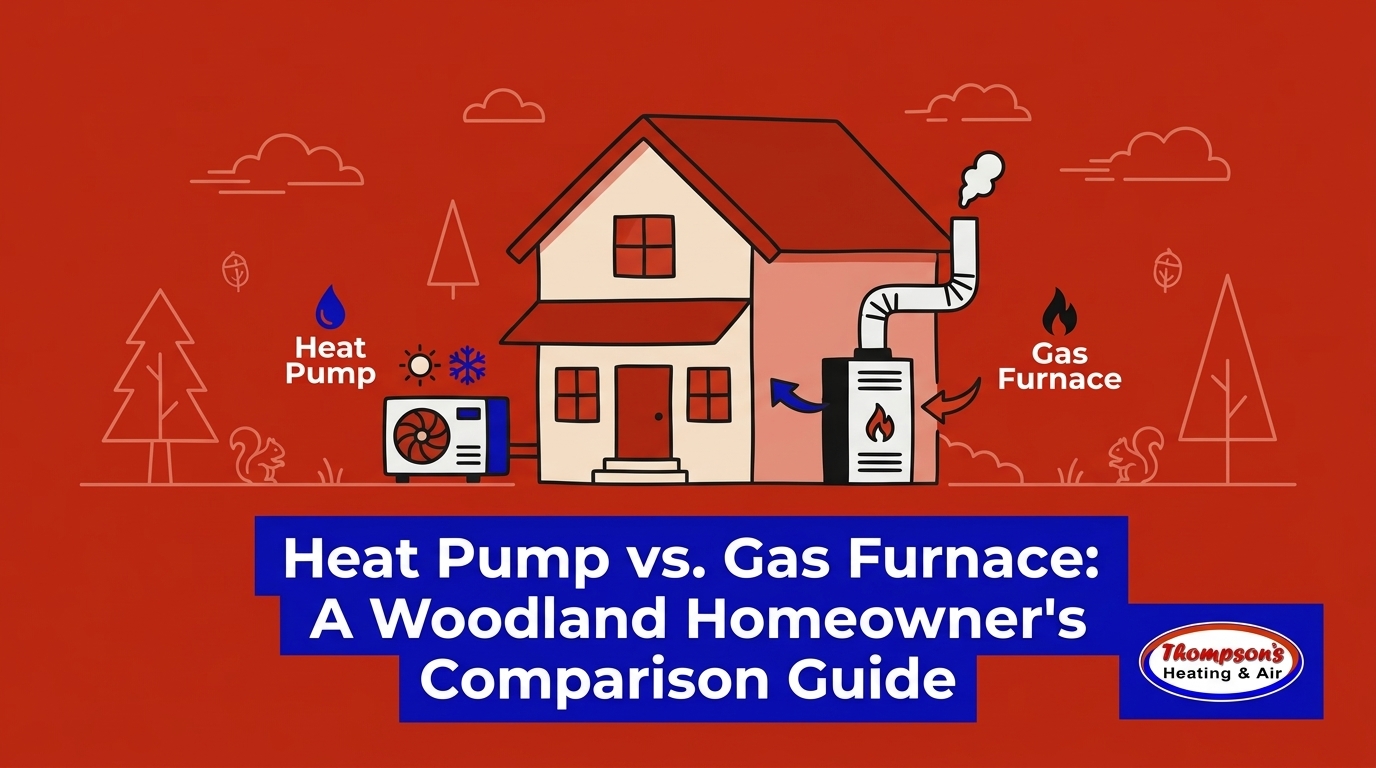
Heat Pump vs. Gas Furnace: A Woodland Homeowner's Comparison Guide

Are Heat Pumps Really Effective for Central Valley Winters?
The idea that you absolutely must rely on a traditional combustion system to stay warm is one of the most persistent myths our team at Thompson's Heating & Air encounters when providing heating options comparisons for homeowners. For decades, the standard advice dictated that electric heating was simply too weak to handle winter weather, leaving natural gas as the only reliable choice. However, modern HVAC technology has completely transformed how we heat our homes, particularly in mild climates. As you evaluate your equipment during your pre-winter heating startup this October, it is the perfect time to challenge old assumptions and look at what actually works best for your specific property.
The decision to install a new heating system is a significant one that impacts your daily comfort, your monthly energy usage, and the overall respiratory environment inside your house. While wrapping up the end-of-the-season cooling maintenance, many of our customers realize they need to proactively plan their winter heating strategy rather than waiting for a complete breakdown in December. Before committing to an installation, focusing on your home's Indoor Air Quality and scheduling routine AC maintenance can help clarify what your home actually needs.
Modern electric heating impacts your indoor environment quite differently than older combustion systems. Choosing between a heat pump and a gas furnace is no longer just a question of which fuel source is available on your street; it is a question of how you want your home to feel, how efficiently you want to operate, and how you want to manage your long-term energy footprint.
Understanding the Sacramento Valley Climate Advantage
If you search the internet for advice on heating systems, you will quickly find generic, national articles claiming that electric heat pumps struggle in the cold. What those articles fail to mention is that they are written for homeowners in Minnesota, Maine, or upstate New York. The climate reality in the Sacramento Valley is entirely different, and in our years of servicing local HVAC systems, we have found that understanding that difference is the key to making an informed decision for your home in Woodland, CA.
During a typical winter in our region, average low temperatures generally hover in the upper 30s to mid-40s. While we occasionally see a brief frost, deep, sustained freezes are incredibly rare. This specific temperature range—the 30s and 40s—is the absolute optimal performance zone for modern heat pump efficiency. In this climate, a heat pump can extract ambient thermal energy from the outdoor air and move it inside with remarkable ease, rarely needing to rely on energy-intensive auxiliary heat strips.
Cutting through the noise: As local technicians who have spent years navigating the specific Sacramento Valley climate, our team prioritizes honest, localized advice over generic national manufacturer claims. A system that is considered a "backup" option in the Midwest is actually a primary, high-performance powerhouse right here in Woodland. Because our winter lows are so mild, both traditional gas furnaces and modern electric heat pumps are highly viable, effective options. The right choice depends entirely on your home's existing infrastructure, your energy goals, and your personal comfort preferences.
Gas Furnaces: The Traditional Central Heating Standard
For generations, the natural gas furnace has been the undisputed king of residential heating. If you live in an older home in Woodland, CA, our installation crews find there is a very high probability that a gas furnace is currently sitting in your attic, closet, or garage. These systems generate heat through a process of controlled combustion. Natural gas is ignited in a burner, and the resulting hot combustion gases pass through a metal heat exchanger. Your blower motor forces indoor air over this hot metal, warming the air before distributing it through your ductwork.
During a pre-winter heating startup in October, our technicians spend a significant amount of time inspecting these heat exchangers for microscopic cracks, as the combustion process inherently produces carbon monoxide. Safe, traditional heating requires proper venting to ensure these exhaust gases are safely carried out of your home.
Advantages of Gas Heating
• Familiar technology for older homes: If your home is already plumbed for natural gas and has a standard electrical panel, swapping an old furnace for a new one is a straightforward, predictable process.
• High heat output for rapid warming: Gas furnaces produce air that is extremely hot—often leaving the vents at 120 degrees Fahrenheit or higher. This provides a blast of heat that warms a cold room very quickly.
• Reliable performance regardless of outdoor temperature drops: Because a furnace creates its own heat through fire, its heating capacity is completely unaffected by how cold it gets outside.
Drawbacks of Gas Heating
• Requires a municipal gas line connection: You are tied to the local natural gas infrastructure and subject to fluctuating fossil fuel commodity rates.
• Combustion safety considerations: Burning fuel indoors always carries a baseline risk. Strict maintenance and active carbon monoxide monitoring are non-negotiable safety requirements.
• Only provides heating: A furnace is a single-purpose machine. You will still require a completely separate central air conditioning unit to handle the long, hot Central Valley summers.
Heat Pumps: Two-in-One Efficiency for Mild Winters
A heat pump operates on an entirely different principle than a gas furnace. Instead of burning fuel to create heat, a heat pump uses electricity and advanced refrigerants to move heat from one place to another. Even when it feels cold outside in Woodland, CA, there is still a significant amount of thermal energy in the air. A heat pump captures this ambient heat, compresses the refrigerant to increase its temperature, and transfers that warmth inside your home.
The most remarkable feature of a heat pump is its reversing valve. In the summer, the system acts exactly like a standard air conditioner, pulling heat out of your house and dumping it outside. In the winter, the valve flips, and the exact same equipment pulls heat from the outside and brings it indoors. This dual functionality is why we see heat pumps rapidly becoming the standard for new installations in mild climates.
However, when we help homeowners switch from gas to electric heating, we often notice a psychological barrier. Because a heat pump transfers heat rather than creating it with fire, the air coming out of the vents is usually around 95 to 100 degrees Fahrenheit. It feels warm, but it lacks the intense "blast" of a gas furnace. The system runs longer, slower, and more consistently to maintain the temperature, which is a different operational feel for those used to traditional systems.
Advantages of Heat Pumps
• Highly energy-efficient heat transfer: Because moving heat takes far less energy than creating it, heat pumps can operate at efficiency levels well over 100 percent under the right conditions.
• Replaces both the furnace and air conditioner: You only have to purchase, maintain, and eventually replace one primary piece of equipment for year-round comfort.
• No risk of carbon monoxide leaks: With no combustion, no flames, and no exhaust gases, the risk of carbon monoxide poisoning from your heating system is entirely eliminated.
Drawbacks of Heat Pumps
• Different operational feel: The system runs more frequently and produces a gentler, lower-temperature airflow, which can take some getting used to.
• May require electrical panel upgrades: Older homes built primarily for gas appliances might need an electrical service upgrade to handle the amperage required by a modern heat pump system.
• Defrost cycles can briefly alter air temperature output: On particularly cold, damp mornings, the outdoor unit may briefly enter a defrost mode to melt away frost, which temporarily changes the system's operation.

How Your Heating Choice Impacts Your Home's Air
Beyond simply warming the rooms, your choice of heating technology has a profound secondary effect on your home's interior environment. One of the most noticeable differences between gas and electric heating is how they interact with indoor humidity levels. Natural gas furnaces, especially older models, can aggressively dry out the air inside your home. The high heat of combustion combined with the heavy draw of air can leave your skin feeling dry, increase static electricity, and irritate your respiratory system during the winter months.
Heat pumps, because they operate at lower, steadier temperatures, tend to maintain a more balanced indoor humidity level. They do not scorch the air, resulting in a more comfortable, natural-feeling environment. However, proper fan operation is critical regardless of the system chosen. Many of our customers wonder how running your AC fan continuously affects humidity during the summer, and the same principles apply to winter heating circulation. Leaving the fan set to "on" rather than "auto" can cause moisture to re-evaporate into the home, altering your comfort levels.
Ultimately, your heating equipment is just one part of your home's respiratory system. If you are struggling with stale air, excessive dust, or lingering odors, upgrading your primary equipment is the perfect time to explore comprehensive Woodland indoor air quality services. Integrating whole-home filtration or active air purification directly into your new system ensures that the air circulating through your home is as clean as it is comfortable, regardless of whether you choose gas or electric heat.
Comparing Energy Efficiency and Long-Term Value
When our team evaluates the long-term value of a new system, we emphasize that understanding how efficiency is measured is critical. Gas furnaces and heat pumps use entirely different metrics to grade their performance, which can make side-by-side comparisons confusing for homeowners in Woodland, CA.
Gas furnaces are measured by AFUE (Annual Fuel Utilization Efficiency). This percentage tells you how much of the natural gas is converted into usable heat versus how much is lost as exhaust. A high-efficiency gas furnace might have an AFUE of 96 percent, meaning almost all the fuel is turned into heat. However, a gas furnace can never exceed 100 percent efficiency because it cannot create more energy than the fuel contains.
Heat pumps are measured by HSPF (Heating Seasonal Performance Factor). Because heat pumps move heat rather than generate it, they can routinely achieve effective efficiencies of 200 to 300 percent. For every unit of electricity consumed, the system can transfer two or three units of heat into your home. As we watch the industry shift toward electrification and reducing household carbon footprints, this incredible efficiency makes heat pumps highly attractive.
• Efficiency Metric — Modern Gas Furnace: AFUE (Up to 98% efficient) — Modern Heat Pump: HSPF (Effectively 200-300% efficient)
• Energy Source — Modern Gas Furnace: Natural Gas (Fossil Fuel) — Modern Heat Pump: Electricity
• Environmental Impact — Modern Gas Furnace: Produces localized carbon emissions — Modern Heat Pump: Zero localized emissions; supports electrification
• Financial Incentives — Modern Gas Furnace: Standard local utility rebates may apply — Modern Heat Pump: Federal tax credits may apply to qualifying high-efficiency installations
A note on incentives: The push toward high-efficiency electric heating means that federal tax credits may apply to qualifying high-efficiency heat pump installations, improving your long-term return on investment. We always advise homeowners to check current federal and local utility guidelines to see how these generic incentives might offset the initial installation costs.
Why Fall is the Ideal Time to Upgrade Your HVAC System
Timing your replacement correctly is just as important as choosing the right equipment. Year after year, our emergency dispatchers see what happens when homeowners wait until their furnace completely fails on the coldest night of the year to start looking at their options. Waiting for a mid-winter breakdown limits your choices, forces rushed decisions, and often leads to settling for whatever equipment is currently sitting on a supplier's shelf.
Using your pre-winter heating startup in October as a deadline for your decision offers several distinct advantages:
1. Proactive evaluation: Scheduling your fall maintenance allows a technician to evaluate your current system's overall health. If the heat exchanger is showing signs of fatigue, you can plan a replacement on your own timeline.
2. Solving two problems at once: If your home required frequent AC repair in Woodland over the summer, your cooling system is likely failing. Replacing the entire system with a heat pump in the fall solves your upcoming winter heating needs and your future summer cooling needs in a single installation.
3. Avoiding the holiday rush: Once November arrives, the demand for emergency heating repairs skyrockets. Planning your installation in October ensures you secure a convenient spot on our schedule.
4. Immediate peace of mind: Entering the busy holiday season knowing your home is equipped with a brand-new, highly efficient, and perfectly safe heating system removes a major source of homeowner stress.
Confidently Choose the Right Heating System for Your Home
Both heat pumps and gas furnaces are excellent choices when they are properly matched to the physical layout of your home and your specific comfort goals. While traditional gas heating offers the familiar blast of high-temperature air, the local climate conditions in Woodland, CA heavily favor the incredible efficiency and dual-functionality of a modern heat pump.
You do not have to make this decision alone. The best way to determine which technology will serve your family best is to consult with a local expert who can evaluate your ductwork, your electrical panel, and your insulation levels. If you are preparing for the winter season and want to weigh your options, reach out to Thompson's Heating & Air to schedule a thorough evaluation of your current system. We are here to provide the honest, localized guidance you need to keep your home perfectly comfortable all year long.
Frequently Asked Questions
Is a heat pump better than a gas furnace in California?
In many parts of California, particularly the Central Valley, a heat pump is highly advantageous due to the mild winter climate. Because temperatures rarely drop into deep freezes, heat pumps operate at peak efficiency, offering both heating and cooling from a single unit. However, "better" depends on your home's existing infrastructure, such as your electrical panel capacity and whether you already have gas lines installed.
At what temperature does a heat pump become inefficient?
Older heat pumps used to lose efficiency around 40 degrees Fahrenheit, but modern systems maintain high efficiency well below freezing. For homes in the Sacramento Valley, where winter lows typically sit in the upper 30s, a modern heat pump will remain highly efficient all season long. It is only in sustained, sub-zero temperatures—which we do not experience locally—that a standard heat pump relies heavily on auxiliary heating.
Should I replace my gas furnace with a heat pump?
Replacing a gas furnace with a heat pump is a smart move if your air conditioner also needs replacing, as the heat pump will handle both tasks. It is also an excellent choice if you want to reduce your reliance on fossil fuels, eliminate the risk of carbon monoxide, and take advantage of modern energy efficiencies. We highly recommend having one of our technicians assess your home's electrical capacity first to ensure it can support the new electric system.
Do heat pumps work in Northern California winters?
Yes, heat pumps work exceptionally well in Northern California winters. As we have seen across hundreds of local installations, the moderate climate of the valley floor provides the exact ambient conditions that allow heat pumps to extract thermal energy efficiently. They are more than capable of keeping your home comfortable during our typical cold fronts without the high operational costs associated with older electric resistance heating.
What is a dual fuel heat pump system?
A dual fuel system combines an electric heat pump with a gas furnace for backup heating. The heat pump handles the heating during mild winter weather to maximize efficiency, and the system automatically switches to the gas furnace only if the temperature drops to a point where combustion heating is more economical. While popular in colder states, our team finds they are often unnecessary for the mild winters in our local area.
Does a heat pump dry out the air as much as a gas furnace?
No, a heat pump generally does not dry out the indoor air as aggressively as a traditional gas furnace. Because a gas furnace uses high-temperature combustion, it tends to bake the moisture out of the air as it circulates. A heat pump produces a steadier, lower-temperature heat that helps maintain a more natural and comfortable indoor humidity level throughout the winter.



.avif)
.avif)
.png)
