
Will Running Your HVAC Fan Reduce Humidity? A Seasonal Home Maintenance Checklist

Why the Fall Transition Challenges Your Home's Comfort and Air Quality
Have you noticed the air inside your house feeling surprisingly sticky or stale as the summer heat finally begins to break? If you are putting together your seasonal home maintenance checklist, managing indoor humidity and preparing your mechanical systems for colder weather should be at the very top of your priorities. During the mid-fall / October heating startup, your HVAC system faces a unique set of physical challenges as it transitions from months of heavy cooling to its first intensive heating cycles.
With the Sacramento Valley's mild transition seasons, our team at Thompson's Heating & Air often sees homeowners try to save energy by running their HVAC fans without the air conditioning active, which inadvertently spikes indoor humidity and creates a muggy environment indoors. This creates a critical decision point for homeowners: you can either proactively address these mechanical transitions by scheduling a professional inspection, or you can simply flip the thermostat to "heat" when the first cold snap hits and hope the system operates safely. By focusing on your indoor air quality and securing comprehensive AC service in Woodland before the weather turns, you can navigate this seasonal shift with confidence, ensuring your equipment is clean, safe, and ready for winter.
The Core Question: Will Running Your HVAC Fan Reduce Humidity?
The short answer is no—running your HVAC fan continuously does not reduce indoor humidity; in fact, it actively increases it. To understand why this happens, it helps to look at the basic mechanics of how an air conditioning system removes moisture from the air during its normal cooling cycle. Air conditioners perform two types of cooling simultaneously: sensible cooling, which lowers the actual temperature of the air, and latent cooling, which removes airborne moisture. Both of these processes rely entirely on the refrigeration cycle.
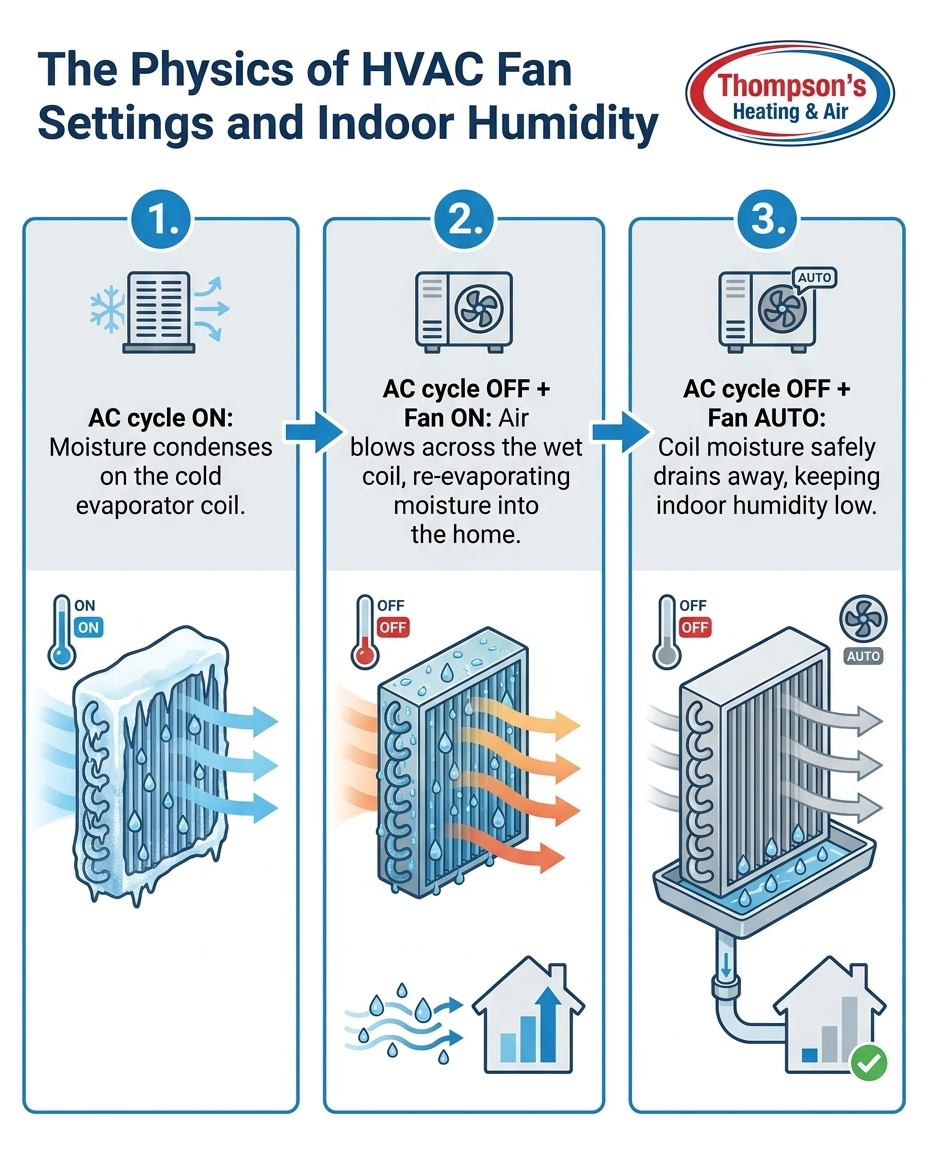
Rather than relying on generic rules of thumb, we believe in providing an honest, physics-based explanation of HVAC settings to reveal exactly why your fan cannot act as a dehumidifier on its own. When our technicians service Woodland CA area homes, we explain that as warm, humid air is pulled through the return vents, it passes over the freezing cold evaporator coil. Because the coil is significantly colder than the air, the airborne water vapor condenses into liquid water on the metal fins—exactly like beads of sweat forming on the outside of a cold glass of iced tea on a warm afternoon. As long as the compressor is running and the coil remains cold, this moisture continues to condense and drip down into the condensate drain pan, safely exiting your home.
The Physics of Evaporator Coils and Moisture Re-Evaporation
The problem arises the moment the cooling cycle finishes. When your home reaches the target temperature, the outdoor compressor shuts off, and the indoor evaporator coil begins to warm back up to room temperature. However, that coil is still dripping wet with all the water it just extracted from your indoor air.
If your thermostat fan is set to the "ON" position, the blower motor continues to force warm, unconditioned air across that wet, warming coil. The passing air acts like a drying breeze, rapidly re-evaporating the condensed water and blowing it straight back through your supply vents. This constant re-introduction of moisture creates a muggy, swampy feeling inside the house, even if the indoor temperature is relatively mild. The fan is essentially undoing all the dehumidification work the air conditioner just performed.
Auto vs. On: Setting Your Thermostat for the Fall Transition
Navigating the shift from summer cooling to the mid-fall / October heating startup requires precise control over your thermostat settings. The choice between "AUTO" and "ON" for your blower fan dictates not only your indoor humidity levels but also your monthly energy consumption and the overall lifespan of your blower motor.
The "ON" setting forces the blower motor to run 24 hours a day, 7 days a week, regardless of whether the system is actively heating or cooling the air. While we frequently hear from homeowners who use this setting in an attempt to filter the air more frequently or balance temperatures between different floors, the drawbacks during the fall transition heavily outweigh the benefits. Continuous airflow guarantees that condensed moisture will be blown back into your living spaces, and running a large electric motor continuously will noticeably inflate your utility bills.
The "AUTO" setting is the superior choice for maintaining optimal indoor humidity levels and protecting your equipment. In this mode, the fan only engages when the thermostat calls for active heating or cooling. Once the target temperature is reached, the entire system—including the fan—shuts down. This critical pause allows the condensed water on the evaporator coil to properly drain away into the condensate line rather than being blown back into the house. By making this simple setting change, you prevent your air conditioner from fighting against itself and maintain a much more comfortable indoor environment.
• ON — Airflow Behavior: Runs continuously (24/7) — Humidity Impact: Increases humidity by re-evaporating coil moisture — Energy Usage: High (constant motor operation)
• AUTO — Airflow Behavior: Runs only during active heating/cooling cycles — Humidity Impact: Lowers humidity by allowing moisture to drain — Energy Usage: Efficient (runs only when needed)
Your Essential Seasonal Home Maintenance Checklist for HVAC
As the weather shifts, it is time to transition your focus from daily thermostat adjustments to broader seasonal preparation. A comprehensive seasonal home maintenance checklist ensures that your home is structurally and mechanically prepared for the colder months ahead. While many homeowners focus on cleaning gutters or storing patio furniture, our technicians know firsthand that the most critical tasks revolve around the safety and reliability of your heating system before the mid-fall / October heating startup.
Here is what should be on your immediate radar:
• Replace all indoor air filters: Summer cooling demands push a massive volume of air through your filters, leaving them clogged with dust, pollen, and pet dander. Starting the heating season with a fresh filter prevents airflow restrictions that can overheat your furnace or strain your heat pump.
• Test carbon monoxide (CO) detectors: Before any combustion-based heating appliance is turned on for the season, verify that every CO detector in your home has fresh batteries and responds to a test button press. This is a non-negotiable safety step.
• Clear outdoor unit debris: Fall winds blow leaves, twigs, and dirt into the fins of your outdoor heat pump or AC condenser. Carefully brush away external debris to ensure the unit has at least two feet of clear airflow on all sides.
• Inspect and open all supply vents: Walk through your home and ensure no furniture, rugs, or curtains are blocking your floor or wall registers. Closing vents in unused rooms disrupts system pressure and can cause mechanical damage.
• Schedule your professional tune-up: While basic clearing and filter changes are excellent DIY tasks, internal mechanical and electrical checks are strictly for licensed professionals. Securing an HVAC maintenance plan ensures that a certified Thompson's Heating & Air technician inspects your heat exchanger, tests safety switches, and calibrates your system before the cold weather hits.
Framing your checklist around mechanical reliability and safety, rather than just generic household chores, ensures you are protected from sudden breakdowns when you need your heating system the most.
Upgrading Indoor Air Quality Before Winter Seals Your Home
As temperatures drop, homes are sealed tightly to prevent drafts and keep the cold air out. While this is excellent for energy efficiency, it creates a significant challenge for indoor air quality. In tightly sealed Woodland CA area homes, trapped stale air, volatile organic compounds (VOCs) from household cleaners, and improper humidity levels become amplified because the house can no longer "breathe" naturally with the outdoors.
Your standard HVAC system has limitations when it comes to managing severe humidity, dryness, or microscopic pollutants without dedicated equipment. A standard 1-inch fiberglass filter is designed to protect the blower motor from large debris, not to purify the air you breathe. When homes are sealed for winter, indoor pollutant levels can easily rise to two to five times higher than outdoor levels, according to the EPA.
To combat this, our IAQ experts recommend whole-home solutions that work in tandem with your existing HVAC system. Upgrading to dedicated air filtration systems, such as thick media cabinets or electronic air cleaners, allows your system to capture microscopic allergens, mold spores, and airborne viruses before they circulate through your living spaces. Additionally, understanding how humidifiers work with your HVAC system is crucial for the later winter months, when the constant operation of a furnace can strip the remaining moisture from your air, leading to dry skin, static shock, and cracked woodwork. Proactively addressing these IAQ upgrades in the fall ensures a healthier environment once the windows are locked shut for the season.
Safety First: Navigating the First Fall Heating Startup
Skipping professional maintenance before the heating season begins introduces serious mechanical and safety risks to your home. When a heating system sits idle for months during the spring and summer, dust, pet hair, and airborne debris naturally settle onto the internal heating components, burners, and heat exchangers.
During the mid-fall / October heating startup, this accumulation of debris is suddenly exposed to extreme temperatures. A pattern we see often on our first fall service calls is homeowners alarmed by that notorious burning smell the first time they turn on the heat. While a brief odor is common as minor dust burns off, heavy accumulation can create a genuine fire hazard or cause sensitive flame sensors to fail, resulting in a system that repeatedly shuts itself down.
Furthermore, the specific mechanical strain of switching a system from months of cooling to intensive heating cannot be overstated. Electrical connections expand and contract with temperature changes, which can loosen wires over time. Moving parts that have sat dormant need to be lubricated, and safety limit switches must be tested to ensure they will cut power if the system overheats. Because these tasks involve high-voltage electricity, pressurized refrigerants, and combustible gases, internal mechanical inspections and tune-ups require a licensed HVAC professional. Attempting to clean a heat exchanger or adjust a gas valve without proper training is dangerous and can easily void your manufacturer warranty.
Frequently Asked Questions About HVAC Fan Settings and Fall Maintenance
Will running my HVAC fan reduce humidity?
No, running your HVAC fan continuously actually increases indoor humidity. When the air conditioning cycle ends, the fan blows warm air across the wet evaporator coil, re-evaporating the condensed water and pushing it back into your living spaces. To keep humidity low, always set your fan to "AUTO" so moisture has time to drain away.
What should be on a fall home maintenance checklist?
A thorough fall checklist should prioritize mechanical safety and airflow. Key tasks include replacing your HVAC air filter, testing all carbon monoxide and smoke detectors, clearing leaves and debris away from your outdoor heat pump or AC unit, and scheduling a professional heating inspection before the cold weather arrives.
Why is my house so humid in the fall?
Mild fall weather often leads to high indoor humidity because your air conditioner isn't running long enough to extract moisture from the air. Short cooling cycles lower the temperature quickly but fail to complete the latent cooling process. Leaving your thermostat fan set to "ON" exacerbates this by blowing trapped moisture back into Woodland CA area homes.
When should I schedule fall HVAC maintenance?
The best time to schedule fall maintenance is in September or early October, just before you need to rely on your heating system daily. Booking an inspection before the mid-fall / October heating startup ensures that any worn parts are replaced before they fail under the strain of freezing overnight temperatures.
Should I leave my thermostat fan on auto or on to control moisture?
You should always leave your thermostat fan on "AUTO" to effectively control indoor moisture. The AUTO setting ensures the fan only runs when the compressor or furnace is actively conditioning the air, allowing the condensate drain pan to properly empty out between cycles without blowing wet air back into the house.
What is the most important fall HVAC maintenance task for safety?
The most critical safety task is having a licensed professional inspect your heat exchanger and combustion chamber. A cracked heat exchanger can leak deadly carbon monoxide into your home's ductwork, and only a trained technician with specialized equipment can safely verify that your heating system is venting exhaust gases correctly.
Secure Your Comfort Before the Cold Weather Arrives
Mastering your thermostat fan settings and understanding the physics of indoor airflow are excellent first steps toward a more comfortable home, but true peace of mind requires a proactive approach to your equipment. By completing your seasonal home maintenance checklist early, you protect your system from the severe mechanical strain of the mid-fall / October heating startup and prevent unexpected breakdowns during the coldest nights of the year.
Do not wait for a freezing morning to find out if your heating system is safe and reliable. A clear, expert evaluation of your equipment's mechanical health is the smartest move you can make right now. Secure your comfort and safety by scheduling professional AC service in Woodland today, ensuring your home is perfectly prepared for whatever winter brings.



.avif)
.avif)
.png)
