A Comprehensive Guide to HVAC System Lifespan


How Old Is Too Old for an HVAC System — and What It Means for Woodland Homeowners
Knowing how old is too old for an HVAC system can be the difference between a planned, stress-free upgrade and a frantic emergency call in the middle of a 105°F Sacramento Valley summer. Most HVAC systems are built to last somewhere between 15 and 20 years — but age alone doesn't tell the whole story. Nearly one in three homeowners faces a major HVAC failure before their system even reaches its expected lifespan.
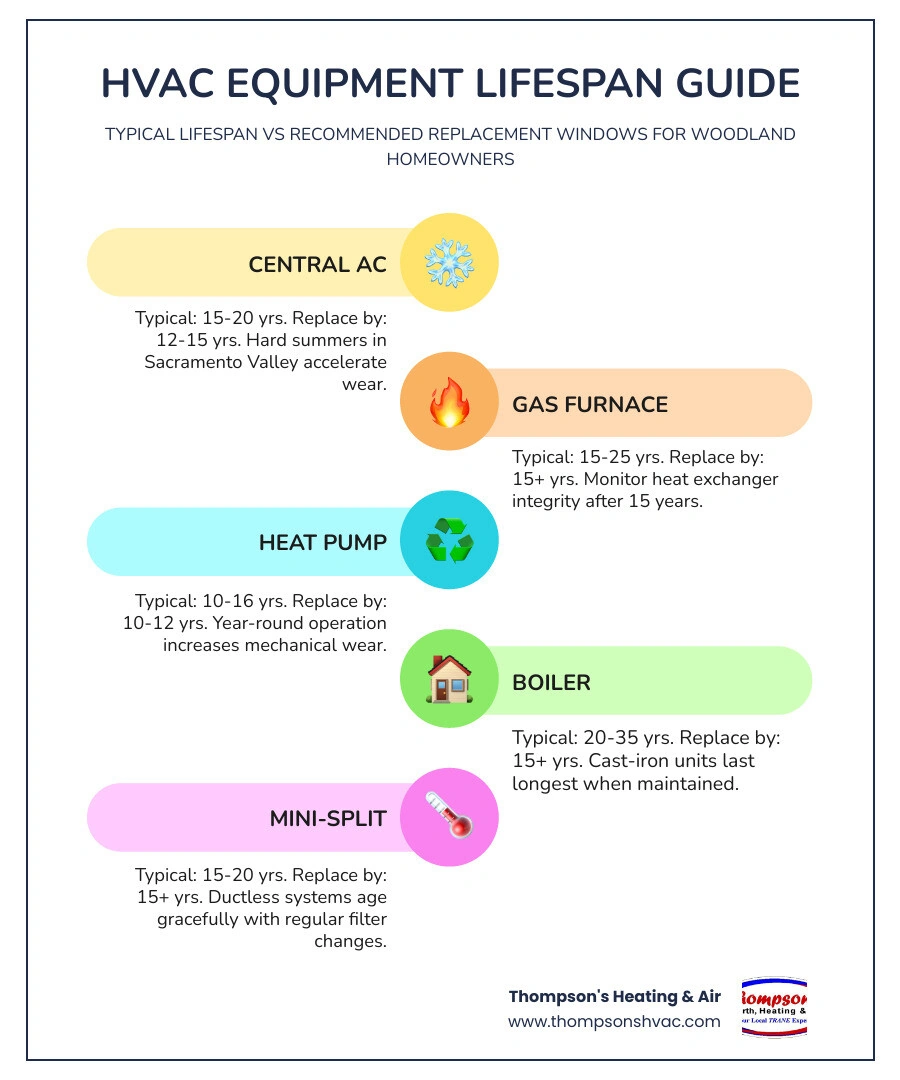
Here's a quick reference by equipment type:
• Central Air Conditioner — Typical Lifespan: 15-20 years — Consider Replacement At: 12-15 years
• Gas Furnace — Typical Lifespan: 15-25 years — Consider Replacement At: 15+ years
• Heat Pump — Typical Lifespan: 10-16 years — Consider Replacement At: 10-12 years
• Boiler — Typical Lifespan: 20-35 years — Consider Replacement At: 15+ years
• Ductless Mini-Split — Typical Lifespan: 15-20 years — Consider Replacement At: 15+ years
If your system is approaching or past these windows — especially here in Woodland where summers run long and your AC works harder than in most of the country — it's worth taking a closer look before your equipment makes the decision for you.
This guide walks you through the warning signs, the replacement math, the safety risks, and how to figure out exactly how old your system really is.
Typical Lifespan of Heating and Cooling Equipment
When we talk about the lifespan of an HVAC system, we have to look at the individual components. A complete home comfort system is rarely a single "box." It is a collection of mechanical units working in tandem, and each has its own operational life expectancy.
• Central Air Conditioners: Under optimal conditions, a modern central air conditioner typically lasts 15 to 20 years. However, older units or those subjected to heavy workloads often reach their functional limit around 10 to 12 years.
• Gas Furnaces: Furnaces generally enjoy the longest lifespan of any ducted system, often lasting 15 to 25 years. Because they operate only during our milder Northern California winters, they experience less cumulative wear and tear than cooling equipment.
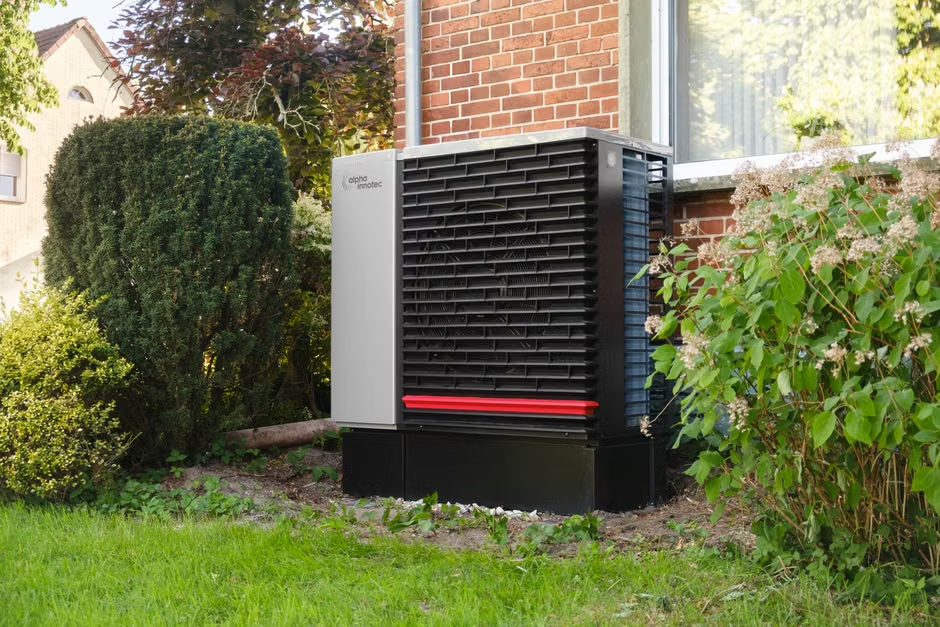
• Heat Pumps: Because heat pumps provide both heating in the winter and cooling in the summer, they work year-round. This constant operation means they have a shorter average lifespan, typically lasting between 10 and 16 years.
• Boilers: Boilers are exceptionally durable, with average lifespans ranging from 20 to 35 years, particularly if they feature heavy-duty cast-iron heat exchangers.
• Ductless Mini-Splits: These versatile systems usually last 15 to 20 years. Because they allow for zoned heating and cooling, individual indoor air handlers can be turned off in unused rooms, reducing overall mechanical wear.
While these ranges are the industry standards, a system that is neglected can fail much sooner. Conversely, a well-maintained system can often last longer than one that is ignored, potentially adding several years of reliable service to its lifespan. Understanding How a Maintenance Plan Extends Equipment Life is the first step in protecting this critical home investment.
How Climate and Usage Affect System Longevity in Northern California
In the Sacramento Valley, our climate plays a massive role in how quickly heating and cooling systems age. Homeowners in Woodland, Davis, Dixon, and West Sacramento experience long, scorching summers where temperatures routinely climb into the triple digits.
This extreme heat translates to high run-hours. While an air conditioner in a milder climate might run for only a few hundred hours a year, a system in Yolo County is under intense seasonal stress for months on end. The constant cycling to combat outdoor heat accelerates mechanical wear on compressors and fan motors.
Additionally, the transition between hot, dry summer days and cool delta breezes can create rapid temperature swings. This puts thermal stress on outdoor metal components. Over time, high humidity levels during spring can also contribute to "formarytic corrosion" on copper evaporator coils, leading to microscopic pinhole leaks that drain refrigerant and force the system to work twice as hard to cool your home.
How Old Is Too Old for an HVAC System?
As a system ages, it reaches what we call the "reliability inflection point." For most central cooling systems, this occurs around the 12-year mark. By year 12, even a well-maintained system has completed thousands of heating and cooling cycles.
At this stage in its life cycle, mechanical components naturally begin to wear down, and efficiency begins to degrade. An air conditioner that started its life operating at peak efficiency may only operate at 80% to 85% of its original capacity by year 12 due to internal wear, coil fouling, and minor electrical degradation.
Furthermore, older systems were built to outdated efficiency standards. Today's systems must comply with modern SEER2 (Seasonal Energy Efficiency Ratio 2) standards, which require much higher baseline efficiency. Upgrading an obsolete unit to a modern, high-efficiency system can dramatically lower your monthly energy consumption. To learn more about how a timely upgrade pays off, read about Why HVAC Replacement is a Smart Investment.
Determining How Old Is Too Old for an HVAC System Using the 50% Rule
When you are faced with a sudden system failure, you need a logical way to decide whether to authorize a repair or invest in a new system. The "50% Rule" is a widely accepted economic decision framework used by HVAC professionals.
The rule is simple: if the cost of a single repair exceeds 50% of the cost of a brand-new system, replacement is almost always the smarter financial choice. Paying for a major repair on a system that is already near the end of its typical lifespan is often a temporary fix. You risk spending a significant amount of money on a repair, only to have a different component fail a few months later. If you are currently weighing these options, our guide on Should I Repair or Replace My HVAC System can help you navigate this decision.
Determining How Old Is Too Old for an HVAC System Using the Age-Multiplied Repair Rule
Another highly reliable method for evaluating an aging system is the Age-Multiplied Repair Rule (frequently referred to as the mathematical triage rule). This rule helps you factor in both the age of the equipment and the immediate repair estimate to see if a repair makes financial sense.
To apply this rule, you multiply the age of your system in years by the cost of the proposed repair. If the resulting number exceeds a standard industry threshold, it indicates that the system has reached the end of its useful economic life, and replacement is recommended. For example:
• A minor repair on a 6-year-old system will yield a low score, making a repair the obvious choice.
• A major component failure on a 13-year-old system will yield a very high score, signaling that your money is better spent on a modern replacement.
This mathematical approach removes the emotion from the decision and helps you look at your HVAC system as a long-term financial asset. For a deeper dive into this calculation, check out our HVAC Repair vs Replace Guide 2026.
Key Warning Signs Your Aging System Needs Attention
Your HVAC system will rarely fail completely without giving you a few warning signs first. Paying attention to these indicators can prevent you from getting caught in a summer heatwave without cooling.
• Rising Energy Bills: If your utility bills are steadily climbing but your heating and cooling habits haven't changed, your system is losing its efficiency. It has to run longer and work harder to achieve the temperatures set on your thermostat.
• Uneven Temperatures: Are some rooms in your Woodland home icy cold while others remain stiflingly hot? An aging system often struggles to distribute conditioned air evenly through your ductwork.
• Strange Noises: Squealing, banging, rattling, or grinding noises are clear indicators of mechanical distress. These sounds often point to failing motor bearings, a slipping belt, or a compressor nearing the end of its life.
• Frequent Breakdowns: If you find yourself calling for service multiple times a year, those minor repairs are adding up. A pattern of recurring failures is a major sign of an unstable system.
If you notice any of these symptoms in your home, it is important to act quickly. You can read more about identifying these issues in our article on Signs Your AC Needs Repair.
Safety Risks of Keeping an Obsolete System
While a failing air conditioner is highly inconvenient, an aging heating system can pose genuine safety risks to your household.
The primary concern with older gas furnaces is the integrity of the heat exchanger. The heat exchanger is the metal chamber that keeps toxic combustion gases — including carbon monoxide — separate from the air that circulates through your home. Over decades of heating cycles, the metal heat exchanger repeatedly expands and contracts. This thermal stress can eventually cause cracks to form.
A cracked heat exchanger can allow carbon monoxide to leak directly into your living spaces. Because carbon monoxide is colorless and odorless, these leaks are incredibly dangerous. Additionally, aging electrical components, worn-out wiring, and failing safety controls in older systems increase the risk of electrical shorts and localized fires. Understanding When to Call a Professional for AC Problems and heating system anomalies is essential for keeping your family safe.
Refrigerant Phase-Outs and Older Units
Environmental regulations have a massive impact on the long-term viability of older air conditioning units.
If your system was installed before 2010, it likely relies on R-22 refrigerant (often called Freon). The U.S. Environmental Protection Agency (EPA) fully banned the production and import of R-22 in 2020. Because the supply of R-22 is extremely limited, refilling a system with a refrigerant leak has become incredibly expensive.
Furthermore, the industry is currently navigating the phasedown of R-410A refrigerant under the AIM Act. As of 2025 and 2026, manufacturers are transitioning to next-generation, environmentally friendly refrigerants. This means that servicing older R-410A systems will also become more complex and costly over the coming decade. If your older system develops a major refrigerant leak, continuing to patch it up is rarely a sound strategy. We break down these financial trade-offs in our guide on the Cost of Repairing Old HVAC vs Buying New System.
Maximizing Longevity and Finding Your System's Age
While mechanical wear is inevitable, the speed at which your system deteriorates is largely under your control. The difference between a well-maintained system and one that is neglected is stark:
• Meticulous (Annual Service) — Average Lifespan (AC): 18-20 years — Average Lifespan (Furnace): 22-25 years — Operating Efficiency: 95-100% of rating — Unexpected Failure Risk: Very Low
• Neglected (No Service) — Average Lifespan (AC): 10-12 years — Average Lifespan (Furnace): 12-15 years — Operating Efficiency: 70-80% of rating — Unexpected Failure Risk: Very High
To determine where your system stands on this timeline, you first need to know exactly how old it is.
You can find this information by locating the metal manufacturer's nameplate on your equipment. For your outdoor air conditioner or heat pump, this plate is usually located on the back or side of the condenser unit. For your furnace, the plate is typically found inside the front cabinet door.
Once you find the nameplate, look for the manufacture date. If the date isn't clearly printed, locate the serial number. Most manufacturers hide the build date within this serial number. For example, the first four digits of the serial number often represent the week and year the unit was manufactured (e.g., "2214" could mean the 22nd week of 2014). If you want to keep your system running safely for as long as possible, explore our analysis on Is an HVAC Maintenance Plan Worth It.
Frequently Asked Questions about HVAC Longevity
Can a well-maintained furnace last 30 years?
While it is technically possible for some high-quality heating systems — particularly heavy cast-iron boilers — to reach the 30-year mark, it is exceptionally rare for standard residential gas furnaces. Even if a furnace survives for three decades through meticulous maintenance, its internal metal components will have suffered significant fatigue.
Furthermore, a 30-year-old furnace operates at a fraction of the efficiency of a modern unit. Older systems often have an AFUE (Annual Fuel Utilization Efficiency) rating of only 60% to 70%, meaning 30% to 40% of the fuel you pay for is wasted. Modern high-efficiency furnaces boast AFUE ratings of 95% or higher, making an upgrade sensible for both safety and utility savings.
Does a heat pump last as long as a central AC?
No, heat pumps typically have a shorter operational lifespan than standalone central air conditioners. A central air conditioner in Northern California only runs during the warm spring and hot summer months, resting during the winter.
A heat pump, however, provides both heating and cooling. It runs year-round, switching its refrigerant flow to heat your home in the winter and cool it in the summer. This continuous, year-round operation doubles the mechanical wear on the compressor, reversing valve, and outdoor fan motor, which typically limits its lifespan to 10 to 16 years.
Does a new HVAC system help sell a home faster in Woodland?
Absolutely. When homebuyers look at properties in the Sacramento Valley, they pay close attention to the age and condition of the HVAC system. They know how demanding our summers are, and the prospect of having to replace an old, failing AC unit immediately after moving in is a major deterrent.
A brand-new, energy-efficient system provides immediate peace of mind, making your home significantly more appealing on the market. For more details on how this upgrade influences buyers, read Does a New HVAC Help Sell Your Home Faster and check out our guide on How a New HVAC System Increases Home Value.
Conclusion
Determining how old is too old for an HVAC system doesn't have to be a guessing game. By paying attention to warning signs like rising utility bills, frequent breakdowns, and strange noises, and by applying simple decision frameworks like the 50% Rule, you can make an informed, proactive decision for your home.
Since 1992, Thompson's Heating & Air has provided family-owned, reliable home comfort solutions throughout Yolo County. Whether you are in Woodland, Davis, Winters, Dixon, or West Sacramento, our experienced team is here to provide honest, professional assessments of your heating and cooling equipment.
We can help you determine if a simple repair will safely extend the life of your current unit, or if it is time to transition to a modern, energy-efficient system. Don't wait for your system to fail on the hottest day of the year. Schedule an HVAC maintenance and repair consultation with Thompson's Heating & Air today to keep your home comfortable all year long.



.avif)
.avif)
.png)
