
How to Lower AC Bills During Summer: 7 Proven Methods


Why Summer AC Bills Spike — and What You Can Do About It Right Now
If you're trying to figure out how to lower AC bills during summer, here's the short answer:
7 proven ways to lower your AC bills this summer:
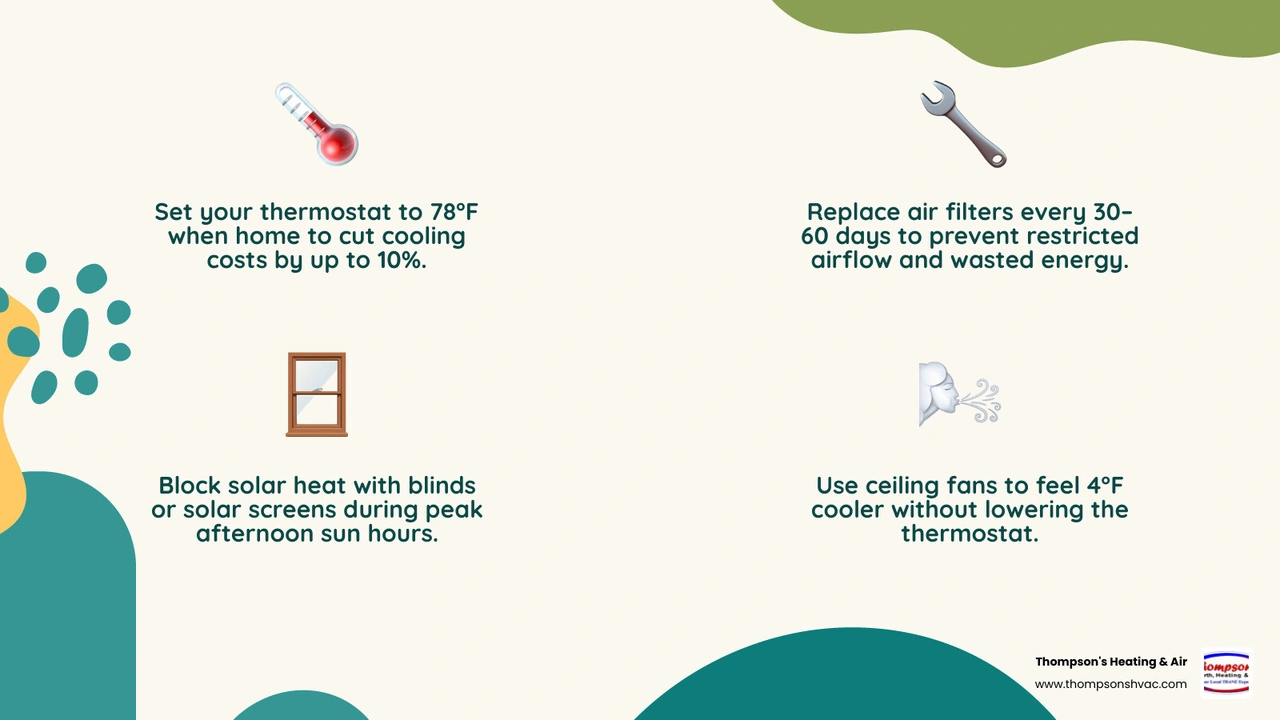
1. Set your thermostat to 78°F when home and raise it when you're away
2. Replace air filters every 30–60 days to prevent airflow restrictions
3. Schedule a professional AC tune-up before peak heat arrives
4. Seal duct leaks and air gaps around doors, windows, and attic penetrations
5. Use ceiling fans to feel cooler without dropping the thermostat
6. Block solar heat gain with blinds, curtains, or solar screens during peak sun hours
7. Shift heat-generating activities like cooking and laundry to the evening
Here in Woodland, CA, summer is no gentle season. Temperatures regularly push well past 100°F across Yolo County, and your air conditioner runs hard to keep up. That relentless demand shows up fast on your electricity bill.
According to the U.S. Department of Energy, air conditioners account for at least 6% of all electricity used in the United States — costing homeowners collectively around $29 billion every year. And for individual households, cooling alone can make up anywhere from 40 to 70 percent of a summer energy bill. The average American household spends roughly $422 on electricity across June, July, and August combined.
The good news? A large portion of that cost is avoidable. Most homes are losing cooling energy through clogged filters, leaky ducts, unshaded windows, and inefficient thermostat habits — problems that are genuinely fixable without a full system replacement. The seven strategies in this guide are practical, backed by real data, and designed for homeowners dealing with the specific heat conditions of the Sacramento Valley.
How to Lower AC Bills During Summer with Smart Thermostat Strategies
Managing your thermostat is the single fastest, zero-cost way to start chipping away at those eye-watering summer utility bills. Many homeowners believe that keeping a house ice-cold all day is the only way to stay comfortable, but smart management can keep you just as comfortable for a fraction of the cost.
The golden rule of summer energy efficiency is to keep the difference between the indoor and outdoor temperatures as small as possible. The closer your indoor setting is to the outdoor temperature, the slower heat will seep into your home, and the less work your air conditioner has to do.
The Department of Energy recommends setting your thermostat to 78°F (25.6°C) when you are at home and active. While 78°F might sound a bit warm at first, pairing this setting with active air movement (like a ceiling fan) makes it feel multiple degrees cooler.
When you leave the house for more than a few hours, don't let the AC cool an empty room. Adjusting your thermostat temperature by seven to ten degrees higher (to around 85°F) for eight hours a day can shave up to 10% off your electric bill each year. If you are looking to optimize your home's setup, a professional Smart Thermostat Installation: Why West Sacramento Experts Are Worth It can take the guesswork out of these daily adjustments.
Use a Smart Thermostat to Automate Your Schedule
Remembering to adjust the thermostat every time you leave for work or go to bed is a chore. That is where smart and programmable thermostats shine. These devices automate your cooling schedule, ensuring you never accidentally pay to cool an empty house.
A smart thermostat learns your daily routine and automatically adjusts temperatures based on your habits. Many models use geofencing technology to detect when your smartphone leaves the neighborhood, automatically shifting the system into an energy-saving "away" mode. On average, smart thermostats can reduce summer cooling bills by 15%.
Additionally, smart thermostats allow you to practice strategic "pre-cooling." In many parts of Yolo County—including Davis, CA and West Sacramento, CA—utility companies charge higher rates during peak afternoon hours. With a smart thermostat, you can program your system to run slightly cooler in the morning when electricity rates are low and outdoor temperatures are mild. This stores thermal energy in your home’s walls and furniture, allowing you to ride through the expensive afternoon peak hours with minimal AC usage.
Avoid the Mistake of Cranking the Temperature Down
We have all done it: you walk into a warm house, grab the thermostat, and crank it down to 60°F in hopes of cooling the room down faster.
Unfortunately, this is a major thermodynamic myth. Air conditioners do not work like a car accelerator; they do not pump colder air just because you set a lower target. Your AC blows air at the exact same rate and temperature regardless of whether you set it to 70°F or 60°F.
Cranking the temperature down only ensures that the compressor runs continuously for a much longer period, likely overshooting your actual comfort level and wasting a massive amount of energy. Every degree below 24°C (approximately 75°F) can increase your AC's electricity consumption by 6% to 8%. Set the thermostat to your actual target temperature—ideally 78°F—and let the system do its job at its own natural pace.
2. Maintain Your System to Keep Efficiency High
Your air conditioner is a finely tuned machine. When dust, dirt, and wear-and-tear take their toll, the system has to work twice as hard to deliver the same amount of cool air. Regular maintenance is not just about preventing breakdowns; it is directly tied to how to lower AC bills during summer.
A poorly maintained air conditioner can operate 25% to 40% below its rated efficiency. This means you are paying full price for a system that is only delivering a fraction of its cooling potential. By keeping the system clean and well-calibrated, you ensure that every watt of electricity translates directly into refreshing indoor comfort. For comprehensive care, scheduling professional AC Maintenance Services ensures your system is operating at peak performance.
Replace Air Filters Regularly to Prevent Airflow Restrictions
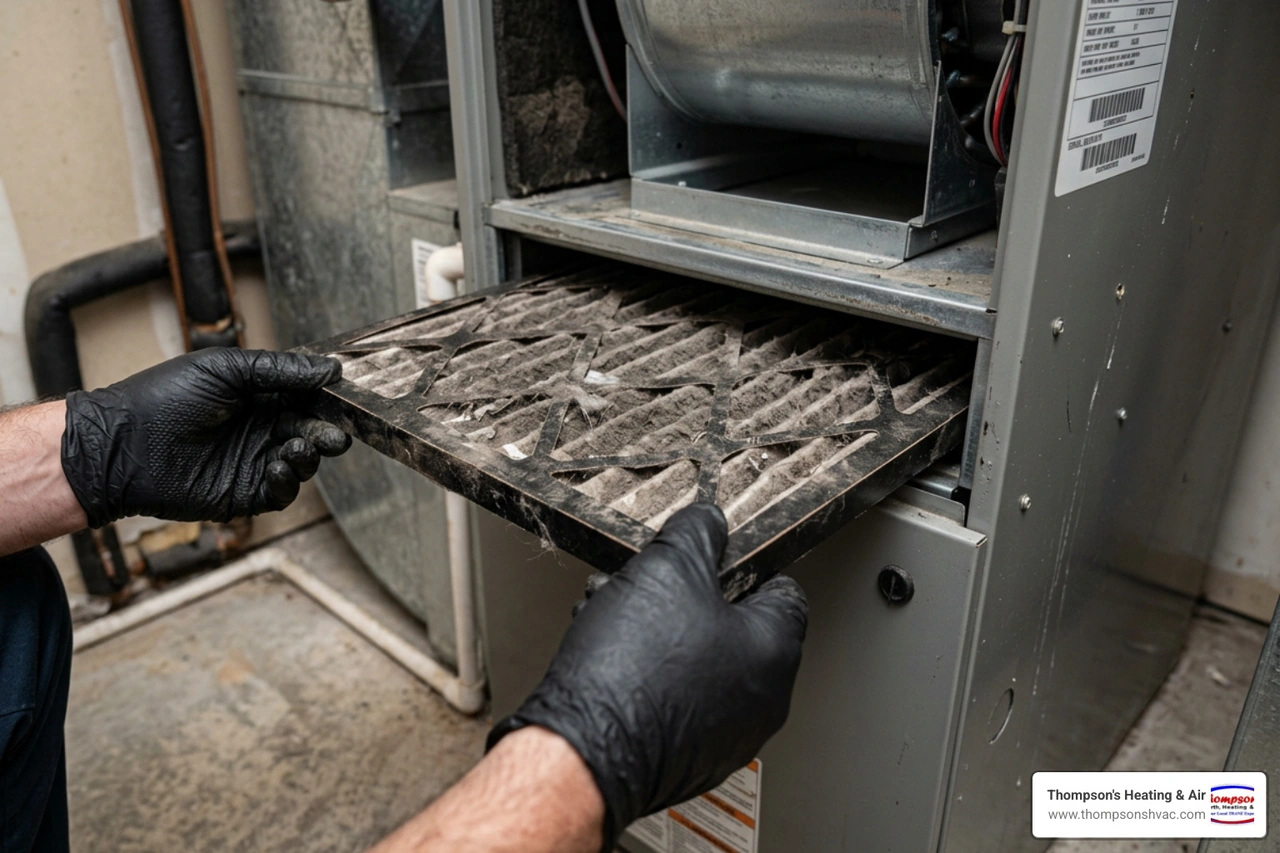
The single most important DIY maintenance task is replacing your air filter. Your HVAC system relies on constant, unobstructed airflow to transfer heat out of your home. When the filter becomes clogged with dust, pet dander, and pollen, the blower motor has to work much harder to pull air through the system.
This restricted airflow causes two major problems: it skyrockets your energy usage, and it can cause your evaporator coils to freeze over, leading to an unexpected system shutdown.
Clearing a clogged AC unit filter alone can save 5% to 15% in energy use. During the peak summer months in hot, dry areas like Esparto, CA and Winters, CA, we recommend checking your filter every 30 days. If you have pets or suffer from seasonal allergies, you may need to replace it monthly. At a minimum, never let a filter go longer than 60 days during the cooling season.
Schedule Professional Tune-Ups Before the Heat Waves Hit
While changing the filter is an excellent DIY habit, your air conditioner has complex electrical and mechanical components that require a professional eye. An annual pre-summer tune-up is the best way to ensure your system is prepared for the brutal Sacramento Valley heat.
During a professional tune-up, a technician will:
• Clean the condenser and evaporator coils (dirty coils can reduce efficiency by over 20%).
• Check and calibrate refrigerant levels (low refrigerant forces the compressor to run longer).
• Inspect electrical connections and lubricate moving parts to reduce friction.
• Clean the condensate drain line to prevent water damage and mold growth.
Scheduling this service in the spring ensures you beat the summer rush when technicians are busy handling emergency breakdowns. To understand the full scope of how this keeps your system running affordably, explore our Affordable AC Maintenance Guide Woodland, CA. Taking care of these details early offers incredible long-term peace of mind, especially when you consider the unique Benefits of Regular HVAC Maintenance in Hot Dry Valley regions.
3. Leverage Passive Cooling and Home Improvements
Sometimes the best way to help your air conditioner is to stop heat from entering your home in the first place. This concept, known as passive cooling, relies on building science to keep your indoor spaces naturally cooler.
By upgrading your home's thermal envelope—including insulation, air sealing, and window treatments—you drastically reduce the cooling load on your AC. In fact, proper insulation and air sealing alone can reduce cooling costs by 10% to 50%, depending on your home's age and climate zone. It is a highly effective way of Getting Your Cooling System Ready for Warm Weather before the outdoor temperatures become unbearable.
How to Lower AC Bills During Summer by Sealing Duct Leaks
If your home uses a central air conditioning system, it relies on a network of ducts to distribute cooled air. Unfortunately, the average residential duct system is incredibly inefficient. A typical home loses 20% to 30% of its conditioned air through loose joints, cracks, and poor duct connections.
When cold air leaks into your attic or crawlspace, your AC has to run much longer to cool your actual living areas. This duct leakage essentially forces you to pay to cool spaces where nobody lives.
Sealing these leaks with specialized duct mastic or foil tape is one of the highest-ROI home improvements you can make. By keeping the cold air inside your living spaces, you can lower your overall cooling load by 10% to 15% and enjoy more even temperatures across every room in your house.
Use Window Coverings to Block Solar Heat Gain
Windows are beautiful, but they are also thermal weak points. Solar radiation streaming through unprotected glass accounts for up to 40% of unwanted heat gain in a typical home.
You can easily combat this "greenhouse effect" by managing your window treatments strategically:
• Close the Blinds: Keep blinds, curtains, or drapes closed on south- and west-facing windows during the hottest parts of the day (typically 10 AM to 5 PM). Medium-colored draperies with white plastic backings can reduce heat gain by up to 33%.
• Install Cellular Shades: Highly efficient cellular (honeycomb) shades can reduce solar heat gain through windows by up to 62%.
• Consider Solar Screens: Exterior solar screens or reflective window films are excellent investments for homes in sunny spots like Dixon, CA or Natomas, CA, blocking the sun's rays before they ever touch the glass.
4. Use Fans and Dehumidifiers to Assist Your AC
Your air conditioner does not have to do all the heavy lifting on its own. By pairing your AC with simple air-movement and moisture-control tools, you can stay perfectly comfortable at much higher thermostat settings.
The most common tool at your disposal is the humble ceiling fan. While fans do not actually lower the temperature of a room, they create a "wind chill effect" on your skin. This moving air helps evaporate moisture from your body, making you feel up to four degrees cooler than the actual ambient air temperature.
• Ceiling Fan — Average Wattage: 50 – 75 Watts — Estimated Operating Cost Per Hour: $0.01 – $0.02
• Central Air Conditioner — Average Wattage: 3,000 – 5,000 Watts — Estimated Operating Cost Per Hour: $0.36 – $0.50
As you can see, running a ceiling fan uses a tiny fraction of the energy required to run a central AC. By utilizing fans, you can comfortably raise your thermostat setting from 74°F to 78°F, cutting your cooling electricity usage significantly.
Run Ceiling Fans Counterclockwise for a Wind Chill Effect
To get the most out of your ceiling fans, you must ensure they are rotating in the correct direction for the season. In the summer, your fan blades should rotate counterclockwise (when looking up at the fan).
This counterclockwise motion pushes a column of air directly downward, creating the refreshing breeze you need to feel cool.
Note: Because fans cool people and not rooms, leaving a ceiling fan running in an empty room is a waste of electricity. Always turn the fan off when you leave the room to maximize your savings.
Control Indoor Humidity to Feel Cooler at Higher Temperatures
Temperature is only half of the comfort equation; humidity plays a massive role in how hot a room actually feels. When the air is humid, your body's natural cooling mechanism (sweat evaporation) slows down, making the air feel sticky, heavy, and hot.
While Yolo County generally experiences a dry summer climate, indoor activities like showering, cooking, and washing dishes can quickly build up localized humidity inside a sealed home.
Using your bathroom and kitchen exhaust fans during and after these activities helps vent warm, humid air directly outside. If your home struggles with high indoor humidity, running a dedicated dehumidifier can make a world of difference. Removing excess moisture from the air allows you to feel perfectly comfortable at 77°F or 78°F, preventing you from constantly lowering the AC just to dry out the air.
5. Adjust Daily Habits and Utilize Off-Peak Hours
Often, the path to lower energy bills lies in our daily routines. Small, mindful adjustments to how and when we use household appliances can yield immediate relief on our monthly bills.
Every appliance you run indoors—from your oven to your television—generates heat. When you run these devices during the hottest parts of the day, your air conditioner has to work extra hard to remove that self-generated indoor heat. By being strategic about your daily habits, you can keep your home naturally cooler.
Shift Heat-Generating Activities to the Evening
Your kitchen is a major source of indoor heat. Running a conventional oven can easily raise the temperature of your kitchen and surrounding rooms by several degrees, forcing your AC into overdrive.
To minimize indoor heat generation:
• Cook Outdoors: Fire up the backyard grill for dinner. It keeps the cooking heat entirely outside and makes for a fun summer routine.
• Use Smaller Appliances: When cooking indoors, rely on microwaves, toaster ovens, air fryers, or slow cookers. These appliances use significantly less energy and emit a fraction of the heat of a full-size oven.
• Delay Laundry and Dishwashing: Wait until after 8 PM to run your dishwasher and clothes dryer. Dryers vent hot air, but they also radiate heat into your laundry area. Running them during the cooler night hours prevents your AC from fighting that extra thermal load.
How to Lower AC Bills During Summer with Time-of-Use Pricing
Many local utility providers across Northern California utilize Time-of-Use (TOU) rate plans. Under these programs, the price of electricity fluctuates based on the time of day and overall grid demand.
Typically, peak demand hours occur on hot weekday afternoons (often between 4 PM and 9 PM) when everyone returns home and turns on their cooling systems. During these peak hours, electricity rates can be significantly higher than off-peak morning and late-night hours.
By aligning your AC usage with these rate structures, you can save a substantial amount of money. Practice "pre-cooling" your home by running your AC slightly lower in the morning and early afternoon when rates are cheap. Once the peak hour window hits, raise your thermostat to 80°F or 82°F. Your home’s existing insulation will help retain that morning coolness, allowing you to minimize AC usage during the most expensive hours of the day.
6. Know When to Upgrade to a High-Efficiency System
While maintenance, insulation, and smart habits can work wonders, there comes a point where an old, inefficient air conditioner simply cannot deliver the savings you want. If your system is constantly breaking down or struggling to keep up with the summer heat, it might be time to consider an upgrade.
Modern cooling technology has advanced leaps and bounds over the last decade. Upgrading to a high-efficiency system can instantly slash your summer energy consumption, making it a highly effective long-term investment. To see how the numbers stack up for your home, take a look at our detailed breakdown on How Much Does a High-Efficiency System Save?.
Evaluate the Age and Performance of Your Current Unit
The average lifespan of a central air conditioner in our hot dry valley is about 15 years. As systems age, their mechanical components wear down, and their overall efficiency drops naturally.
If your system is over 10 to 12 years old and has a low SEER (Seasonal Energy Efficiency Ratio) rating, you are likely paying a premium just to keep it running. For comparison, older systems were often rated at 10 to 13 SEER, while modern high-efficiency systems easily reach 18 to 25 SEER. Upgrading from an older 10 SEER system to a modern 16 SEER system reduces cooling energy consumption by 38%, translating to immediate and noticeable relief on your monthly bills.
Choose a Variable-Speed System for Long-Term Savings
If you decide to upgrade, consider investing in a variable-speed (or inverter-driven) system. Traditional air conditioners are single-stage, meaning they are either 100% on or completely off. They blast cold air at full capacity until the thermostat is satisfied, then shut down, repeating this cycle constantly. This frequent cycling uses a massive amount of starting electricity and creates annoying temperature swings.
In contrast, a variable-speed system can modulate its output anywhere between 30% and 100% capacity. It runs continuously at a lower, incredibly efficient speed, adjusting its output precisely to match the real-time cooling needs of your home.
Because it runs longer at lower speeds, a variable-speed system provides:
• Incredible Efficiency: It avoids the massive energy spikes associated with constantly starting and stopping.
• Superior Comfort: It maintains an incredibly consistent indoor temperature with virtually zero hot or cold spots.
• Excellent Humidity Control: Continuous air movement allows the system to extract significantly more moisture from your indoor air, making your home feel naturally cooler.
Frequently Asked Questions
What is the most efficient temperature to set my AC in the summer?
The U.S. Department of Energy recommends setting your thermostat to 78°F (25.6°C) when you are at home and active. This setting provides an ideal balance between indoor comfort and energy efficiency. To maximize your savings, raise the temperature to 85°F when you plan to be away from home for more than four hours.
Does closing vents in unused rooms help lower my energy bill?
No, this is a common myth that can actually increase your energy bills and damage your system. Modern central HVAC systems are engineered to distribute air based on a specific volume of airflow and duct pressure.
When you close supply vents, you increase the static pressure inside your ductwork. This forces your blower motor to work much harder, increases the likelihood of duct leaks, and can even cause your evaporator coils to freeze. Keep all vents open and clear of furniture to maintain proper system balance.
How much can I save by upgrading to a high-efficiency AC system?
Your overall savings will depend on the SEER rating of your current unit and the rating of your new system. However, upgrading from an older 10 SEER system to a modern 16 SEER system can reduce your cooling energy consumption by approximately 38%. If you opt for an ultra-high-efficiency variable-speed system, your savings can be even higher.
Conclusion
Lowering your summer air conditioning bills doesn't require sacrificing your indoor comfort. By taking a layered approach—combining smart thermostat habits, regular DIY maintenance, passive cooling strategies, and mindful appliance usage—you can keep your home beautifully cool while keeping your hard-earned money in your wallet.
Whether you are looking to seal up leaky ductwork, install a smart thermostat, or schedule an annual pre-summer tune-up, our family-owned team is here to help. Since 1992, we have served our neighbors across Woodland, Davis, West Sacramento, Winters, and the surrounding communities with reliable, high-quality comfort solutions.
Ready to make your home more energy-efficient this summer? Contact us today to schedule your next service or explore our professional Thompson's Heating & Air HVAC Maintenance and Repair Services. Let’s keep your home comfortable and your utility bills under control all summer long!



.avif)
.avif)
.png)
