How Much Does a High Efficiency System Save?

How Much a High-Efficiency System Can Save on Your Energy Bills in Woodland, CA
How much does a high efficiency system save is one of the most practical questions a Woodland homeowner can ask — and the short answer is: quite a bit, depending on what you're replacing.
Here's a quick snapshot of realistic annual savings by upgrade type:
• 80% to 96% AFUE furnace — Estimated Annual Savings: $200 – $260/year on heating
• SEER 10 to SEER 15 AC — Estimated Annual Savings: ~33% reduction in cooling costs
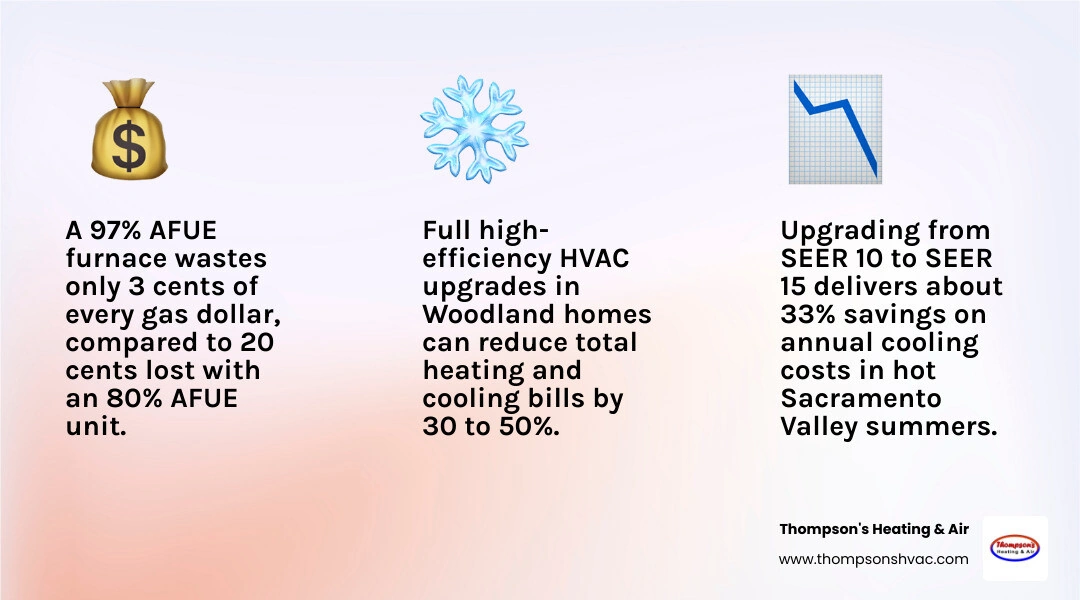
• Full system upgrade (heating + cooling) — Estimated Annual Savings: 30 – 50% total HVAC bill reduction
• ENERGY STAR furnace (Northern region, lifetime) — Estimated Annual Savings: Up to $1,345 over 21 years
Nearly half of the energy used in your home goes to heating and cooling. For Yolo County homeowners already dealing with triple-digit Sacramento Valley summers and cool winter nights, an inefficient system isn't just uncomfortable — it's expensive. Upgrading to a high-efficiency furnace or air conditioner means more of every dollar you spend actually goes toward heating or cooling your home, instead of escaping through exhaust or wasted cycles.
The difference is measurable. A standard 80% AFUE furnace loses 20 cents of every gas dollar as wasted exhaust. A 97% AFUE model loses only 3 cents. Over a full heating season, that gap adds up fast — and in a climate like Woodland's, where AC units can run for thousands of hours each summer, cooling efficiency matters just as much.
This guide walks you through exactly what those savings look like in real numbers, what factors affect your results, and how to make the smartest upgrade decision for your home.
Understanding High-Efficiency Ratings: AFUE and SEER2
When we talk about HVAC efficiency, we use two primary "languages": AFUE for heating and SEER2 for cooling. Understanding these numbers is the first step in answering how much does a high efficiency system save in your specific home.
Annual Fuel Utilization Efficiency (AFUE) measures how efficiently a furnace converts gas into heat. In May 2026, a "standard" furnace is typically an 80% AFUE model. This means 80% of the fuel becomes heat, while 20% is lost through the flue. High-efficiency units, however, boast ratings of 90% to 98.5% AFUE. These units utilize condensing technology to squeeze every bit of warmth out of the fuel.
For cooling, we look at the Seasonal Energy Efficiency Ratio (SEER2). As of 2026, federal minimum standards have risen, but many homes in Woodland are still running older 10 SEER units. Modern high-efficiency systems often reach 18 to 22+ SEER2.
Beyond the ratings, the technology inside makes a massive difference. High-efficiency systems often feature variable-speed motors and modulating gas valves. Unlike standard systems that are either "all on" or "all off," these units function like cruise control, adjusting their output to match your home's needs exactly. This precision is a major reason how properly sized systems affect comfort so significantly; they maintain a steady temperature rather than causing the "blast and chill" cycle of older models. Furthermore, ensuring your system is correctly matched to your home prevents the mechanical stress that occurs when improperly sized systems shorten equipment life.
How much does a high efficiency system save in fuel utilization?
If you upgrade from a standard 80% AFUE furnace to a 97% AFUE model, you are essentially giving yourself a 17% raise on every dollar spent on natural gas. In simple terms, a 97% AFUE furnace returns 97 cents of heat for every dollar spent, compared to only 80 cents for the standard model.
This is achieved through a secondary heat exchanger. In a standard furnace, the hot exhaust gases are vented out of the chimney while they are still quite hot. A high-efficiency condensing furnace passes those gases through a second exchanger, extracting additional heat until the exhaust is cool enough to condense into water. This process significantly reduces gas consumption and improves combustion safety by using a sealed combustion system that draws air from outside rather than from inside your living space.
Comparing cooling efficiency with SEER2 ratings
In the Sacramento Valley, our cooling season is long and intense. Replacing an old 10 SEER air conditioner with a modern 15 SEER unit can create roughly 33% annual savings on your cooling costs. If you move up to an 18 or 20 SEER2 system, the savings can climb toward 50%.
High-efficiency cooling also provides superior humidity control. Because variable-speed compressors can run for longer cycles at lower speeds, they remove more moisture from the air. This often allows you to keep the thermostat a few degrees higher while feeling just as cool. For many in our region, exploring heat pump benefits for Sacramento Valley homeowners is a smart move, as these systems provide high-efficiency cooling and heating in one package.
Factors That Influence Your Total Energy Savings

While the equipment ratings provide a baseline, your actual "real world" savings depend on several external factors. It isn't just about the box we install in your attic or closet; it’s about how that box interacts with your home.
1. Home Insulation: If your attic insulation is thin, your high-efficiency heat will escape just as fast as the "standard" heat did.
2. Ductwork Integrity: Leaky ducts can waste 20% to 30% of your conditioned air before it ever reaches your rooms. Sealing and insulating ducts can improve efficiency by as much as 20%.
3. Usage Patterns: If you prefer a "set it and forget it" approach or use a smart thermostat to manage schedules, your savings will be more consistent.
4. System Sizing: A system that is too large will cycle on and off too frequently (short-cycling), wasting energy during the startup phase.
When these factors are addressed alongside an equipment upgrade, it’s not just about the monthly bill. Homeowners often find that how a new HVAC system increases home value becomes a major factor if they decide to sell, as energy efficiency is a top priority for modern buyers in Woodland and Davis.
How much does a high efficiency system save during Sacramento Valley summers?
Woodland and the surrounding areas experience over 2,000 cooling hours in a typical year. When the temperature hits 105°F in July, a standard AC unit struggles and consumes massive amounts of electricity. A high-efficiency system with a variable-speed compressor handles these peaks far more gracefully.
By running at 40% or 50% capacity for most of the day, a high-efficiency unit avoids the "startup surge" of electricity that happens every time a standard unit kicks on. When combined with zoned cooling—where you only cool the rooms you are actually using—the impact on your PG&E bill can be hundreds of dollars over the course of a single summer. Integrating a smart thermostat adds another 10-15% in potential savings by learning your schedule and enabling "eco-modes" when you're away at work or out at the Farmers Market.
Maximizing Savings with California Rebates and Incentives
One of the best ways to shorten the "payback period" of a high-efficiency system is to take advantage of the various financial incentives available to California residents. These programs can offset the higher upfront cost of premium equipment.
• PG&E Rebates: Local utility programs often provide significant rebates for homeowners who install ENERGY STAR-qualified equipment. For a detailed look at what's available for our neighbors in Woodland and West Sacramento, check out our PGE rebates guide for Sacramento Valley homeowners.
• State Incentives: California frequently offers programs to encourage the transition to cleaner, more efficient heating. You can find more information in our guide to California energy rebates for HVAC and fireplace upgrades.
• Federal Tax Credits: The Inflation Reduction Act has provided long-term tax benefits for energy-efficient home improvements. While specific credits can change, we keep an updated resource on Inflation Reduction Act benefits for California homeowners.
• Application Assistance: Navigating the paperwork can be tricky, so we've put together a step-by-step on how to apply for energy rebates in California.
By stacking these incentives, the net cost of a high-efficiency system often drops to a level very close to that of a standard model, making the choice to go high-efficiency an easy financial "win."
Long-Term Performance and Maintenance Requirements
A high-efficiency system is a precision machine. To ensure you continue to see the savings you're paying for, regular maintenance is non-negotiable. While a standard furnace might "tolerate" a bit of neglect (at the cost of its lifespan), a high-efficiency unit requires specific care.
High-efficiency furnaces produce acidic condensate during the heating process. This water must be drained away properly through dedicated lines. If these lines clog, the system will shut down to prevent water damage. Furthermore, variable-speed motors and secondary heat exchangers should be inspected annually to prevent dust buildup from reducing their effectiveness.
A well-maintained high-efficiency system can last 15 to 20 years for AC units and even longer for furnaces. We recommend following our annual HVAC maintenance complete guide to keep your warranty valid and your efficiency at its peak. Many of our customers in Woodland and Winters find that is an HVAC maintenance plan worth it for the peace of mind and the guaranteed efficiency it provides year-round.
Frequently Asked Questions about High-Efficiency HVAC
What is the typical payback period for a high-efficiency upgrade?
The "payback period" is the amount of time it takes for the energy savings to cover the extra upfront cost of the high-efficiency unit. In our region, the payback period typically ranges from 5 to 12 years.
If gas prices rise or if we have a particularly harsh winter or scorching summer, that period shortens. Additionally, if you utilize the rebates mentioned above, you can often reach the "break-even" point much faster. Given that these systems last 15-20 years, you could enjoy 8 to 15 years of "pure profit" in the form of lower utility bills.
Do high-efficiency systems require specialized maintenance?
Yes, but it isn't necessarily more difficult—just different. The main additions are the condensate drainage system and the more complex electronic controls. You still need to change your filters every 1-3 months, but you also need a technician to ensure the secondary heat exchanger is clean and the drainage pump is functioning. Regular professional tune-ups prevent small issues from becoming expensive repairs.
Is a high-efficiency furnace better than a heat pump in Woodland?
In the Sacramento Valley, we have a "mixed" climate. We don't get the sub-zero temperatures of the Midwest, but we do get chilly. For many of our customers, a dual-fuel system (also known as a hybrid system) is the ultimate solution.
This setup uses an electric heat pump for cooling and for heating during mild spring and fall days. When the temperature drops during a cold December night, the system automatically switches to a high-efficiency gas furnace. This allows you to use the most cost-effective fuel source at any given moment, maximizing your savings regardless of the weather.
Conclusion
Upgrading your HVAC isn't just a home repair; it's a long-term investment in your comfort and your bank account. When you ask, "how much does a high efficiency system save?" you're looking at a reduction in your carbon footprint, an increase in your home's value, and—most importantly—a significant drop in your monthly overhead.
At Thompson's Heating & Air, we've been helping our neighbors in Woodland, Davis, Dixon, and throughout Yolo County since 1992. As a family-owned business, we take pride in providing reliable, 5-star service and helping you choose the system that makes the most sense for your family and your budget. Whether you need a precision tune-up or a full system replacement, our team is available 24/7 to ensure your home stays comfortable.
Ready to start saving? Explore our HVAC installation, maintenance, and repair services today and let us help you count the coins you'll save on your next energy bill.



.avif)
.avif)
.png)
