
Don't Be Standard When You Can Be Highly Efficient


Why the Standard Efficiency vs High Efficiency HVAC Comparison Matters for Woodland Homeowners
The standard efficiency vs high efficiency HVAC comparison is one of the most important decisions you'll make as a homeowner — and getting it wrong can cost you hundreds of dollars every single year.
Here's the quick answer:
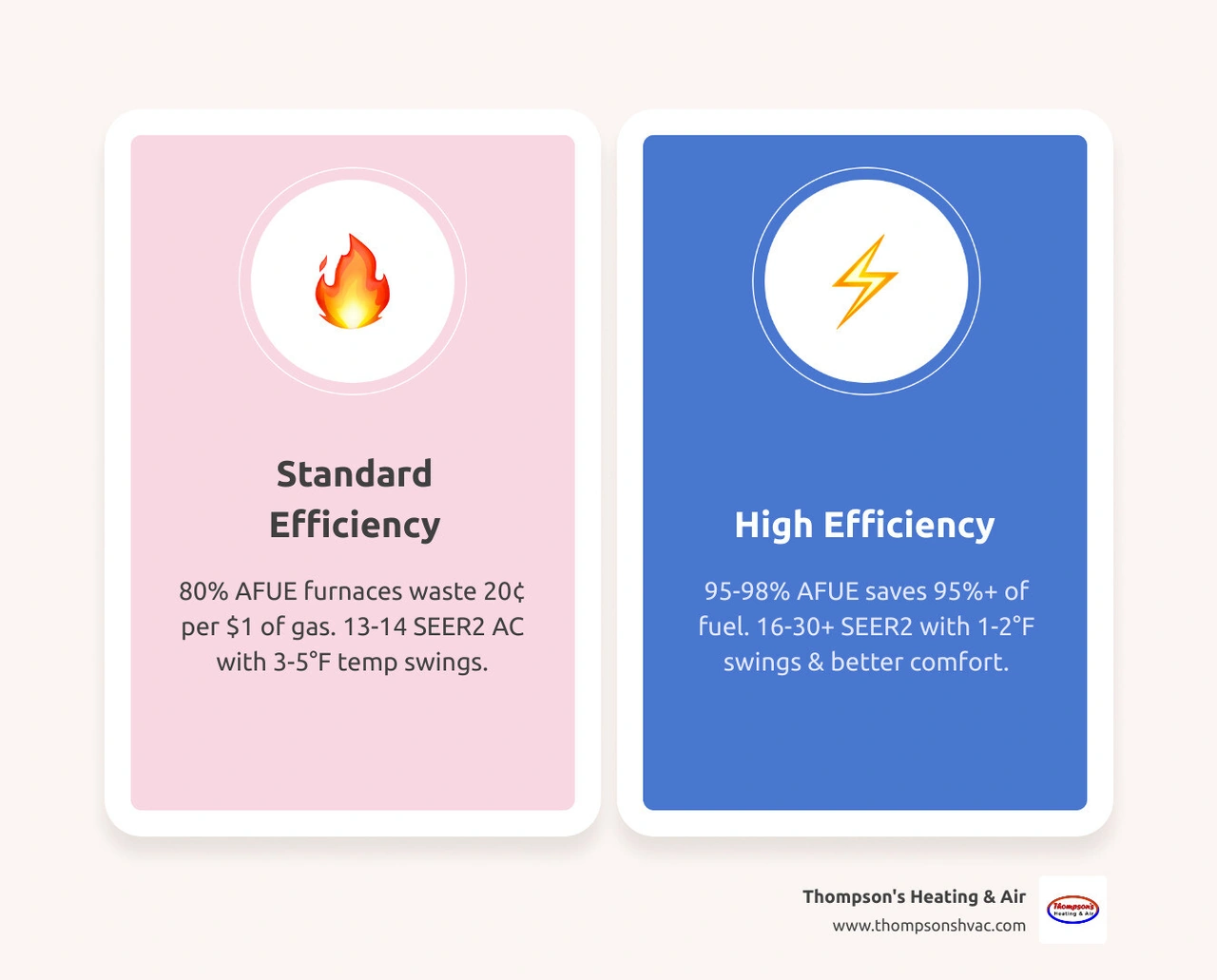
• Furnace AFUE — Standard Efficiency: ~80% — High Efficiency: 95–98%
• AC SEER2 — Standard Efficiency: 13–14 — High Efficiency: 16–30+
• Heat Pump HSPF2 — Standard Efficiency: ~7.7 — High Efficiency: 9.0+
• Fuel wasted per dollar — Standard Efficiency: ~20 cents — High Efficiency: 2–5 cents
• Temperature consistency — Standard Efficiency: 3–5°F swings — High Efficiency: 1–2°F swings
• Upfront cost — Standard Efficiency: Lower — High Efficiency: Higher
• Long-term savings — Standard Efficiency: Lower — High Efficiency: $150–$500+/year
• Best for — Standard Efficiency: Short-term owners, mild climates, tight budgets — High Efficiency: Cold climates, long-term owners, high energy costs
Think of it this way: a standard furnace burns a dollar of gas and throws 20 cents of it straight out the exhaust pipe. A high-efficiency model cuts that waste down to just 2–5 cents. Over a Sacramento Valley winter — where furnaces can run from mid-October through March — that difference adds up fast.
For Woodland, CA homeowners dealing with hot summers and cold valley winters, choosing the right efficiency tier isn't just about saving money on monthly bills. It's about comfort, reliability, and making a smart long-term investment in your home.
This guide breaks down exactly what separates these two system types, which one makes sense for your situation, and what you need to know before you buy.
I'm looking to upgrade my home's heating. How does a standard efficiency vs high efficiency HVAC comparison help?
When we talk about efficiency tiers, we are essentially looking at how much of the energy you pay for actually makes it into your living room as heat or cool air. In our local communities—from Davis to Dixon and Winters—the choice often boils down to an "investment" mindset versus a "budget-friendly" mindset.
A standard efficiency vs high efficiency HVAC comparison starts with understanding energy conversion. Standard systems are the reliable workhorses of the industry. They use traditional technology to meet federal minimum requirements. High-efficiency systems, on the other hand, utilize advanced components like secondary heat exchangers and variable-speed motors to squeeze every possible bit of comfort out of your fuel or electricity.
Before deciding, it is vital to understand How HVAC Load Calculations Work. If a system is too large or too small for your specific square footage and insulation levels, even the most efficient unit will struggle to perform. We always start with a detailed audit of your home’s "envelope"—including windows, ductwork, and ceiling heights—to ensure the unit we install is perfectly matched to your needs.

Decoding AFUE and SEER2 in a standard efficiency vs high efficiency HVAC comparison
To make an informed choice, you need to speak the language of HVAC. There are three main acronyms you’ll see on every yellow EnergyGuide label:
1. AFUE (Annual Fuel Utilization Efficiency): This applies to gas furnaces. A standard furnace typically has an 80% AFUE. This means 80% of the gas becomes heat, while 20% is lost as exhaust. A high-efficiency furnace hits 95% to 98% AFUE. You are essentially getting 17 cents more heat for every dollar spent.
2. SEER2 (Seasonal Energy Efficiency Ratio 2): This measures air conditioning. As of 2026, the federal minimum is roughly 13.4 to 14 SEER2. High-efficiency units can soar to 20 or even 30 SEER2. Think of this like "miles per gallon" for your AC; the higher the number, the less electricity it uses to keep you cool during a 100-degree Woodland July.
3. HSPF2 (Heating Seasonal Performance Factor 2): This measures the efficiency of heat pumps during the heating season. Standard units sit around 7.7, while high-efficiency models reach 9.0 or higher.
Getting the Right Size HVAC for the Sacramento Valley Homes is especially important here because high-efficiency equipment relies on long, steady run cycles to save money. If the system is oversized, it will "short cycle," turning on and off rapidly, which kills the efficiency gains you paid for.
When is a standard unit better in a standard efficiency vs high efficiency HVAC comparison?
We’ll be honest: high-efficiency isn’t always the right answer for every homeowner. There are several scenarios where a standard efficiency system is actually the smarter financial move:
• Short-Term Residency: If you plan on moving in the next two to three years, you likely won't stay long enough to reach the "payback period" where energy savings cover the higher upfront cost.
• Budget Constraints: If your current system has failed unexpectedly and you need a fast, affordable replacement, standard units offer the lowest initial price.
• Mild Usage: If you are cooling a small guest house or a space that is rarely used, the annual savings from a high-efficiency unit might only be $20–$40, making the upgrade hard to justify.
• Space Limitations: High-efficiency furnaces are "condensing" units (more on that below), which means they require new PVC venting and a drain line. In some older homes in Woodland or Davis, routing these new pipes through tight spaces can be prohibitively difficult.
Regardless of which you choose, HVAC Maintenance and Repair remains the most important factor in how long your system lasts. Even a standard unit can provide 15+ years of reliable service if it's cared for properly.
Key Technological Differences: What’s Under the Hood?
The reason a high-efficiency system costs more is that the technology inside is significantly more advanced. While a standard furnace uses a single heat exchanger and a metal flue to vent hot gases outside, a high-efficiency furnace is a "condensing" unit.
It features a secondary heat exchanger made of stainless steel. This second exchanger captures the heat from the exhaust gases that standard units simply throw away. By the time the exhaust leaves the system, it’s so cool that it can be vented through simple PVC pipe instead of a hot metal chimney.
• Heat Exchanger — Standard Efficiency: Single (Aluminized Steel) — High Efficiency: Dual (Primary + Stainless Secondary)
• Blower Motor — Standard Efficiency: Permanent Split Capacitor (On/Off) — High Efficiency: Variable-Speed ECM (Modulating)
• Gas Valve — Standard Efficiency: Single-Stage (100% or 0%) — High Efficiency: Two-Stage or Modulating (40-100%)
• Venting — Standard Efficiency: Metal Flue (Natural Draft) — High Efficiency: PVC Pipe (Sealed Combustion)
• Compressor — Standard Efficiency: Single-Stage — High Efficiency: Variable-Capacity / Inverter-Driven
Another "secret sauce" of high efficiency is the variable-speed blower motor. Standard motors are either on or off—it’s like driving a car that only goes 0 or 60 mph. Variable-speed motors can adjust their speed to the exact needs of the home, often running at just 10% or 15% capacity to maintain a perfect temperature. This uses significantly less electricity and provides much quieter operation.
Our team at HVAC Service Woodland CA often points out that these systems also use sealed combustion. This means they pull fresh air for burning from outside your home rather than using the air you’ve already paid to heat or cool, which improves both safety and indoor air quality.
Comfort, Performance, and Choosing the Right System in Woodland
While the math of energy savings is compelling, the biggest difference most of our customers notice is how the home feels. High-efficiency systems solve many of the common "comfort complaints" we hear in the Sacramento Valley.
• Consistent Temperatures: Standard systems wait for the house to get too cold, kick on at 100% power, and then shut off when it gets too warm. This creates 3–5 degree temperature swings. High-efficiency units modulate, keeping the temperature within 1 degree of your setting.
• Humidity Control: Because variable-speed systems run for longer cycles at lower speeds, they spend more time pulling moisture out of the air. This is a lifesaver during our humid valley mornings.
• Whisper-Quiet Operation: You’ll no longer have to turn up the TV when the heater kicks on. These systems ramp up slowly and often run at decibel levels lower than a quiet conversation.
• Better Air Quality: Because the fan runs more often (at a very low cost), your air is constantly being pulled through your filters, removing more dust, pet dander, and allergens.
Many of these systems integrate perfectly with smart thermostats, allowing you to view energy reports and adjust your climate from your phone. If you're currently dealing with hot or cold spots in your home, it might be time for HVAC Repair Woodland CA or an evaluation to see if a staged system could balance your airflow.
Maximizing ROI with Heat Pumps and Dual-Fuel Systems
In April 2026, many Woodland homeowners are looking toward heat pumps as the ultimate efficiency upgrade. Unlike a furnace that creates heat by burning fuel, a heat pump simply moves heat from one place to another. This process can reduce site energy use by 20% to 40% compared to older AC and gas furnace combinations.
For those who want the best of both worlds, we recommend dual-fuel systems. This setup pairs a high-efficiency electric heat pump with a gas furnace backup. The heat pump handles the mild days (common in Winters and Davis), and the gas furnace takes over only when the temperature drops below freezing. It’s the ultimate way to optimize your utility bills.
When considering an upgrade, HVAC Installation Woodland CA is about more than just the box in the backyard. It's about the ductwork and the sizing. We often see that How Improperly Sized Systems Shorten Equipment Life is the number one reason high-efficiency units fail early. Proper installation ensures you actually see the ROI you were promised.
Frequently Asked Questions about HVAC Efficiency
How long do high-efficiency systems last compared to standard models?
Both standard and high-efficiency systems typically last between 15 and 20 years. However, high-efficiency units are often built with higher-grade materials, such as stainless steel heat exchangers, which are more resistant to corrosion. The key to longevity isn't the efficiency rating—it's the quality of the installation and the consistency of your annual maintenance.
Does a high-efficiency unit require more maintenance?
The routine tasks are largely the same: change your filters, clear the brush away from the outdoor unit, and have a professional inspection twice a year. However, high-efficiency units do have one extra requirement: the condensate drain. Because these units extract so much heat, they produce moisture (condensation) that is slightly acidic. This drain line must be kept clear to prevent the system from shutting down or causing water damage.
Are there rebates available for upgrading in 2026?
Yes! While federal tax credits under the older IRA programs have shifted, many local utility providers in Yolo County and the Sacramento Valley offer substantial rebates for high-efficiency heat pumps and furnaces. These can range from a few hundred to over a thousand dollars, significantly lowering the "efficiency premium" you pay upfront. We always help our customers navigate the current local incentive landscape to find every available dollar.
Conclusion
Choosing between a standard and high-efficiency system is a personal decision that depends on your home, your budget, and your long-term goals. At Thompson's Heating & Air, we’ve been serving the Woodland community since 1992. We aren't here to upsell you on technology you don't need; we're here to provide the local expertise and reliable service you expect from a family-owned business.
Whether you're in Winters, Davis, or West Sacramento, we can help you run the math on a standard efficiency vs high efficiency HVAC comparison to see which one truly fits your life. Our 24/7 technician access and commitment to 5-star service mean we’ll be here long after the installation is complete.
More info about HVAC installation and maintenance
Ready to stop throwing 20 cents of every dollar out the chimney? Give us a call today, and let’s find the perfect system for your Woodland home.



.avif)
.avif)
.png)
