
Ultimate Guide to Ideal Indoor Humidity Levels for Valley Weather


Why Ideal Indoor Humidity Levels for Valley Weather Matter More Than You Think
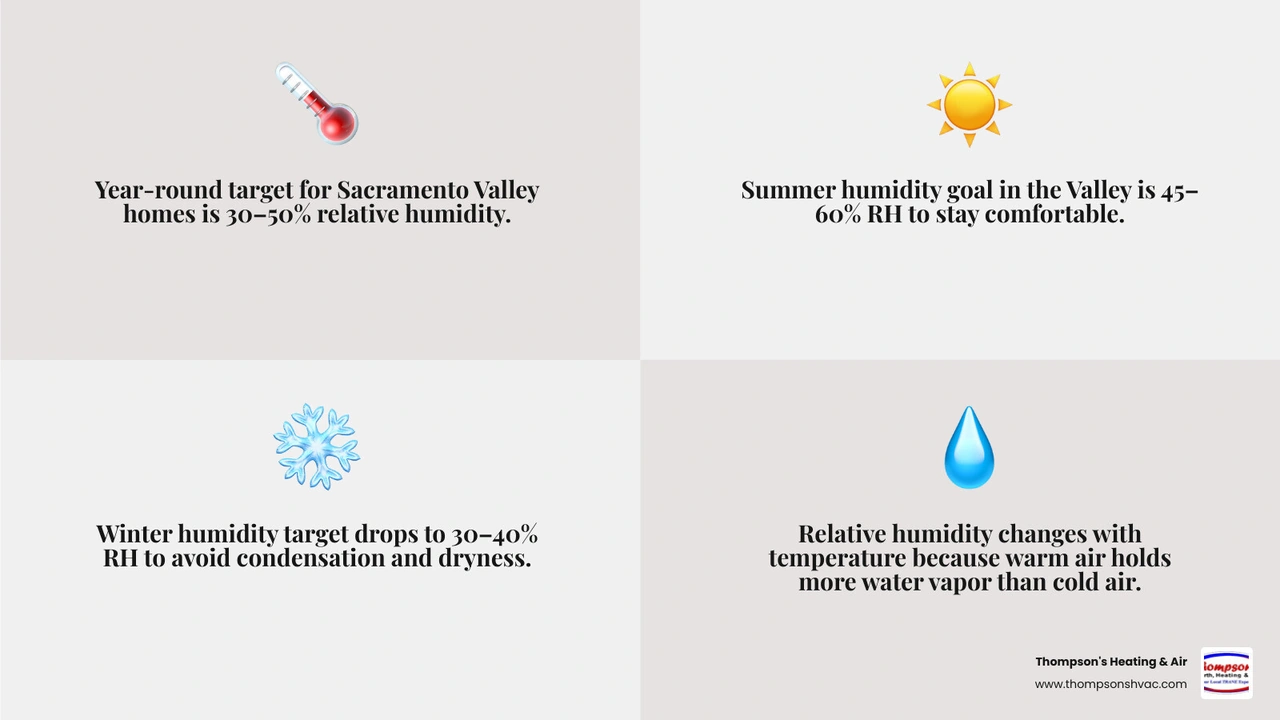
Ideal indoor humidity levels for valley weather fall within the following ranges, depending on the season:
• Summer (Sacramento Valley) — Recommended Indoor Humidity: 45–60% RH
• Winter (Sacramento Valley) — Recommended Indoor Humidity: 30–40% RH
• Year-round target — Recommended Indoor Humidity: 30–50% RH
If you live in Woodland, CA or anywhere in Yolo County, you already know the Sacramento Valley doesn't do things halfway. Summers are long, hot, and dry. Winters are cool and damp. And your home's indoor air quality swings right along with those extremes.
Most homeowners reach for the thermostat when something feels off. But temperature is only half the story. The other half is humidity — and in the Valley, getting it wrong means dry, cracked skin and nosebleeds in January, or muggy, mold-inviting air in August.
The sweet spot is 30–50% relative humidity (RH) year-round, with seasonal adjustments to match what the Valley throws at you. Too low and your airways dry out, your wood floors crack, and cold air feels even colder. Too high and mold, dust mites, and that clammy, uncomfortable feeling move in.
This guide walks you through exactly what humidity ranges to target, how to know when your home is out of balance, and what you can do about it — room by room, season by season.
What Are the Ideal Indoor Humidity Levels for Valley Weather?
When we talk about humidity, we are specifically referring to Relative Humidity (RH). This is the amount of water vapor present in the air expressed as a percentage of the amount needed for saturation at that same temperature. Warm air can hold far more moisture than cold air, which is why a 50% RH reading on a 95°F summer day in Woodland represents much more physical water in the air than a 50% RH reading on a chilly 45°F winter morning in Davis.
For homeowners navigating our unique climate, finding the sweet spot requires a bit of seasonal strategy. While general national standards like those from ASHRAE recommend keeping indoor relative humidity between 30% and 60%, and Health Canada suggests a tighter 30–50% range, our local valley weather demands specialized attention.
To help local homeowners navigate these seasonal shifts, we have developed customized Air Quality Solutions for the Sacramento Valley Homes that keep indoor spaces comfortable, clean, and healthy.
Summer Targets: Keeping Cool in the Sacramento Valley
During our scorching summer months, outdoor relative humidity in Yolo County can drop to single digits during the heat of the day. However, when we run our air conditioners constantly to combat the triple-digit outdoor temperatures, the indoor environment can shift dramatically.
In the summer, the recommended indoor humidity target is 50% to 60% RH (though many homeowners prefer to keep it closer to 40% to 50% to completely discourage mold and dust mites).
Standard air conditioners provide what is called "sensible cooling" (lowering the actual air temperature) but also perform "latent cooling" (removing moisture from the air as a byproduct). Because our AC units run long, intense cycles during July and August, they can strip too much moisture from the air, leaving your home feeling parched and staticky. Conversely, if your system is oversized, it may cool the house so quickly that it shuts off before removing enough moisture, leaving you with cold, clammy, and muggy air.
Understanding How Sacramento Valley Heat Affects Your HVAC and Fireplace is essential to keeping your cooling system operating at peak dehumidification efficiency during these intense periods.
Winter Targets: Avoiding Dry Air and Condensation
When winter arrives in Winters, Esparto, or Natomas, the outdoor air turns cool and damp. However, once that cold outdoor air enters your home and is warmed up by your furnace or heat pump, its relative humidity plummets. This is because heating the air increases its moisture-holding capacity without adding any actual water.
In the winter, the ideal indoor humidity target shifts to 30% to 40% RH.
Keeping your winter humidity within this range is a delicate balancing act. If your indoor humidity rises above 40% during a cold snap, you will likely notice condensation forming on the inside of your windows. This happens because the warm, moist indoor air hits the cold glass pane, reaching its dew point and releasing liquid water. Over time, this condensation can rot wooden window frames, ruin drywall, and foster mold growth.
On the flip side, letting your indoor humidity drop below 30% leads to static shocks, irritated sinuses, and chapped lips. To find out how to balance this, you can explore the Whole House Humidifier Benefits for Dry Climates to see how whole-home solutions keep your winter air perfectly balanced.
Why Humidity Control Matters for Your Health and Home
Many of us think of humidity as a minor comfort issue, but it actually plays a massive role in our physical health, our energy bills, and the structural integrity of our homes. When your indoor air is balanced, your home is healthier, safer, and far more efficient.
To understand the broader picture of how managing your indoor atmosphere affects your physical well-being, read our guide on How Clean Air Improves Your Health and Comfort.
Health Impacts of Dry and Humid Air
Our bodies are highly sensitive to the moisture levels in our surroundings. When indoor humidity drops too low—which is incredibly common during the winter heating season—our health can suffer in quiet but persistent ways.
Low humidity directly impacts our respiratory system's natural defense mechanism: mucociliary clearance. Your nasal passages and throat are lined with tiny, hair-like structures called cilia, which are coated in a thin layer of mucus. This system traps inhaled dust, viruses, and bacteria, moving them safely away from your lungs. When the air is dry, this mucus layer dries out, paralyzing the cilia and leaving you highly vulnerable to airborne infections. In fact, research shows that common viruses like influenza, measles, and rubella survive much longer in environments where the relative humidity is below 50%.
Dry air also takes a toll on your skin and throat. According to a large-scale global study of indoor environments:
• A 10 percentage point increase in relative humidity (across a range of 14% to 70% RH) was associated with a 54% reduction in the odds of reporting dry or itchy skin among females, and a 42% reduction among males.
• For females, that same 10% increase in RH was linked to a 40% reduction in the odds of suffering from a sore or dry throat.
• For males, a 10% increase in RH was associated with a 42% reduction in reported unusual tiredness, fatigue, or drowsiness.
On the other end of the scale, high humidity (above 60%) creates an environment where biological allergens thrive. Mold spores begin to germinate and multiply within 24 to 48 hours in damp conditions. Furthermore, house dust mites—the leading trigger for year-round allergies and asthma—reach their maximum population sizes at high relative humidities up to 80% RH. However, dust mites are nearly eliminated when relative humidity is kept below 40% to 50% RH.
If you or your family members struggle with seasonal allergies, check out our Indoor Air Quality Tips for Allergy Sufferers for targeted strategies to keep these microscopic pests at bay.
Protecting Your Home's Structure and Woodwork
Your health isn't the only thing at stake; your physical home is also highly reactive to moisture. Wood is a hygroscopic material, meaning it acts like a sponge, absorbing and releasing moisture to match the surrounding air.
When your home's humidity is consistently too low, wooden elements will shrink. You may notice:
• Gaps appearing between your hardwood floor planks.
• Crown molding and baseboards pulling away from the walls.
• Wooden doors shrinking, causing them to rattle in their frames.
• Cabinet doors warping or cracking at the joints.
When humidity is consistently too high, the opposite occurs. Wood swells, causing doors to stick in their frames and hardwood floors to cup or buckle. Even worse, excess moisture can seep into wall cavities, leading to hidden mold growth, wood rot, and structural decay that can be incredibly difficult to remediate. Keeping your indoor humidity within the safe 30–50% zone protects your investments and ensures your home's structural integrity remains intact for decades to come.
How to Measure and Manage Your Home's Moisture Levels
Before you can fix a humidity problem, you have to know exactly what you are dealing with. We highly recommend purchasing a digital hygrometer (sometimes called a humidity monitor). These inexpensive, battery-operated devices provide highly accurate, real-time relative humidity readings.
For the most accurate assessment, place your hygrometer in a central living area, about 3 to 5 feet off the ground. Keep it away from localized moisture sources (like the kitchen or bathroom), direct sunlight, and drafty windows or HVAC vents.
Many modern smart thermostats also feature built-in hygrometers. While these are excellent for tracking whole-home trends over time, older wall-mounted models can sometimes be inaccurate if they are placed in drafty hallways or near heat-generating appliances.
Managing these levels requires a combination of smart habits and the right equipment. To understand how balanced ventilation works to keep your air fresh and moisture-controlled, read up on How Fresh Air Exchange Protects Your Family.
Here is a quick look at how portable units compare to whole-home systems:
• Coverage — Portable Humidifier / Dehumidifier: Single room or small localized area — Whole-Home Humidifier / Dehumidifier: Entire house through existing ductwork
• Maintenance — Portable Humidifier / Dehumidifier: High (must refill/empty water daily, clean weekly) — Whole-Home Humidifier / Dehumidifier: Low (annual filter/panel changes during routine service)
• Aesthetics — Portable Humidifier / Dehumidifier: Bulky, takes up floor space, visible cords — Whole-Home Humidifier / Dehumidifier: Completely hidden inside your HVAC system
• Noise — Portable Humidifier / Dehumidifier: Noticeable fan or ultrasonic hum in the room — Whole-Home Humidifier / Dehumidifier: Whisper-quiet operation through central vents
• Control — Portable Humidifier / Dehumidifier: Manual adjustments on the unit — Whole-Home Humidifier / Dehumidifier: Automated control via your central thermostat
Signs Your Valley Home Has a Humidity Imbalance
If you don't have a hygrometer on hand, your home will usually drop subtle hints when its moisture levels are out of whack.
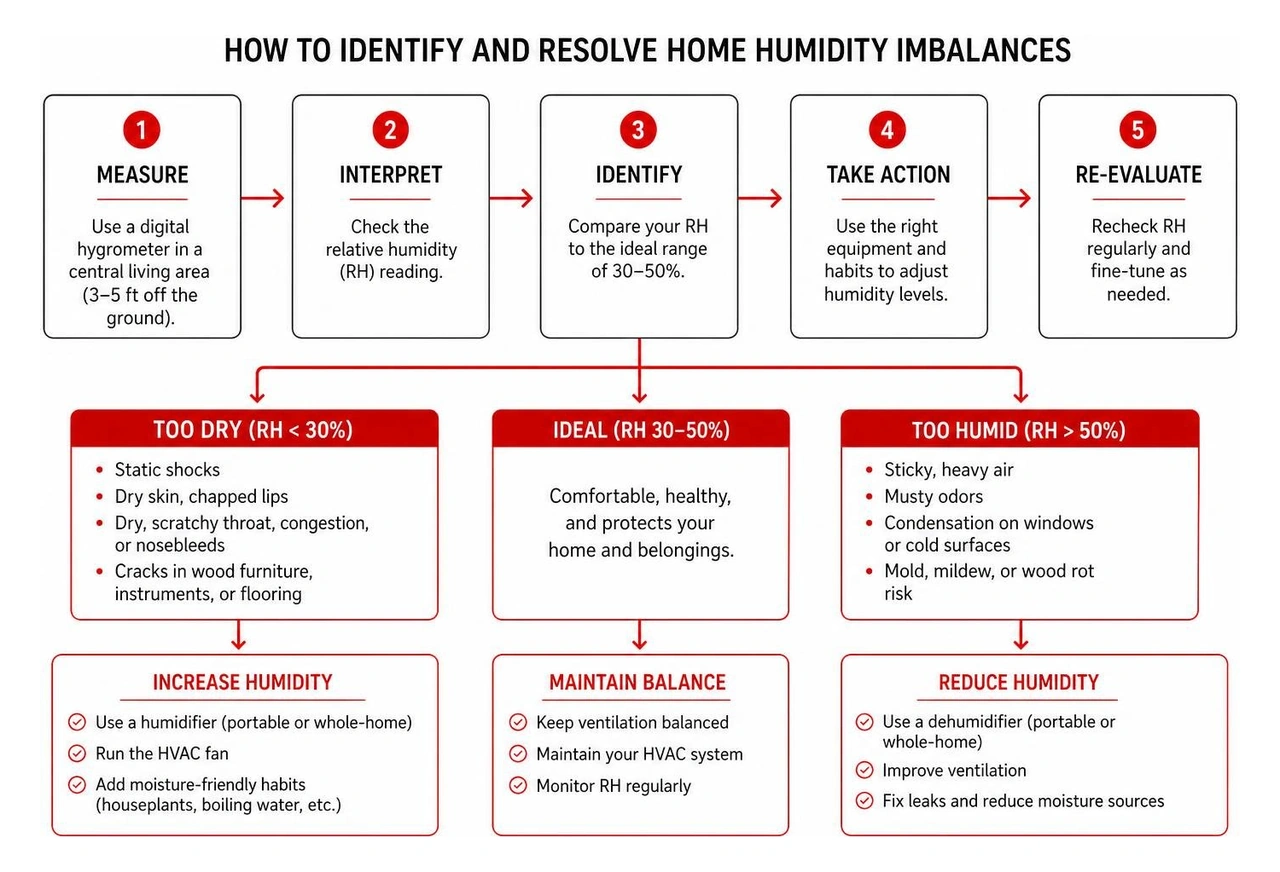
Signs Your Home is Too Dry (RH < 30%):
• You get zapped by static electricity every time you touch a metal doorknob.
• Your skin feels tight, itchy, or flaky, and your lips are constantly chapped.
• You wake up with a dry, scratchy throat, congestion, or occasional nosebleeds.
• Wooden furniture, musical instruments, or flooring exhibit new cracks or creaks.
Signs Your Home is Too Humid (RH > 60%):
• A persistent musty, damp odor lingers in closets, basements, or bathrooms.
• Windows consistently fog up or show beads of condensation, especially in the mornings.
• The indoor air feels heavy, sticky, and warm, making a 75°F room feel like 80°F.
• You notice dark spots or mildew forming on bathroom ceilings, window tracks, or behind furniture.
Achieving Ideal Indoor Humidity Levels for Valley Weather in the Bedroom
Getting a good night's sleep is heavily dependent on your bedroom's microclimate. When we sleep, our body temperature naturally drops. If your bedroom is too hot, too cold, or highly humid, your body will struggle to regulate its temperature, leading to restless tossing and turning, reduced REM sleep, and frequent nighttime awakenings.
For optimal sleep quality, sleep experts recommend keeping your bedroom temperature between 60°F and 67°F and maintaining a relative humidity of 30% to 50%.
High bedroom humidity prevents your sweat from evaporating efficiently, leaving you feeling hot, sticky, and uncomfortable. It also exacerbates respiratory issues like asthma and snoring. On the other hand, a dry bedroom will dry out your nasal passages, leading to a scratchy throat, dry eyes, and a persistent nighttime cough.
Using a smart thermostat to program a slight temperature drop at night, combined with a properly balanced HVAC system, is the most reliable way to maintain this perfect sleep zone.
Maintaining Ideal Indoor Humidity Levels for Valley Weather for Babies and Sensitive Groups
For newborns, infants, and individuals living with respiratory conditions like asthma or severe allergies, proper humidity control is not just a matter of comfort—it is a health necessity.
Babies have incredibly delicate skin that dries out far more quickly than adult skin, making them prone to eczema and painful skin irritations. They also have tiny, narrow nasal passages that are easily blocked by dried mucus when the air is too dry. Keeping a nursery maintained at 40% to 50% RH keeps their airways hydrated, helps them breathe easier, and promotes better sleep.
For those managing asthma, maintaining this exact range is critical. Dust mites and mold are two of the most common indoor asthma triggers. Because dust mite populations are nearly eliminated when relative humidity drops below 50%, keeping your home's air properly dehumidified is one of the most effective non-medical interventions you can make.
To learn more about keeping your home's air clean and safe for sensitive family members, visit our comprehensive service page on Indoor Air Quality.
HVAC Maintenance and Solutions for Valley Humidity Control
While small lifestyle adjustments—like running bathroom exhaust fans for 20 minutes after a shower or boiling water with a lid on—can help on the margins, true year-round humidity control in the Sacramento Valley requires a robust, well-maintained HVAC system.
Modern variable-speed air conditioners and heat pumps are incredible tools for humidity management. Unlike traditional single-stage systems that blast on at 100% capacity and quickly shut off (short-cycling), variable-speed systems run longer, gentler cycles at lower speeds. This constant, steady airflow allows the system's evaporator coil to pull maximum moisture out of the air during hot, humid summer days, keeping your home perfectly dry without overcooling your space.
To make sure your system is up to the task, read about the Benefits of Regular HVAC Maintenance in Hot Dry Valley.
Additionally, because our dry, dusty Valley summers can quickly clog your system's filtration, it is crucial to understand How Hot Dry Valley Affects Filter Replacement Frequency to ensure unrestricted, moisture-clearing airflow.
Humidifier and Dehumidifier Maintenance Best Practices
If you have integrated a whole-home humidifier or dehumidifier into your central heating and air system, keeping it clean is vital. Because these systems handle water, neglecting regular maintenance can turn your comfort equipment into a breeding ground for bacteria and mold.
Follow these best practices to keep your systems running safely:
• Replace Humidifier Water Panels: Also known as evaporator pads, these should be replaced at least once per heating season—or twice if you have hard water, which is common in many parts of Yolo County. Mineral scale buildup blocks airflow and reduces moisture output.
• Inspect the Condensate Drain Line: For dehumidifiers and air conditioners, ensure the drain line is clear of algae, dust, and debris. A clogged drain line can cause water to back up, leading to expensive water damage or system shutoffs.
• Keep Coils Clean: Dust and dirt acting as an insulating blanket on your dehumidifier's coils will drastically reduce its moisture-removal efficiency. Have a professional clean these coils during your annual maintenance visit.
To learn more about advanced filtration and purification options that work alongside your humidity controls, explore our guide on Air Purification.
Frequently Asked Questions About Valley Humidity
What is the healthiest humidity level for a home in Woodland, CA?
The healthiest year-round range for a home in Woodland, CA is 30% to 50% relative humidity. This range is high enough to keep your respiratory passages moist and protect your skin and eyes, but low enough to prevent mold growth and keep dust mite populations at bay. During the peak of summer, aiming for 45% to 50% keeps things comfortable, while dropping to 30% to 35% in the winter prevents condensation on your windows.
Does running the air conditioner reduce indoor humidity?
Yes, but only when it is running a proper cooling cycle. As warm, humid indoor air is pulled across your AC's freezing-cold evaporator coil, the moisture in the air condenses onto the coil (just like water droplets forming on a cold soda can). This water drains out of your home through a condensate line. However, if your air conditioner is oversized for your home, it will cool the space too quickly and shut off before this condensation process can fully take place, leaving you with cold, clammy air.
Why is my house so dry in the winter?
Your house feels dry in the winter because cold outdoor air holds very little physical moisture. When that cold air leaks into your home through doors, windows, and small gaps, and is then heated up to 70°F by your furnace, its relative humidity drops drastically. Heating the air expands its volume and capacity to hold water, making the existing moisture in the air represent a much lower percentage of total capacity.
Conclusion
Finding and maintaining the ideal indoor humidity levels for valley weather doesn't have to be a guessing game. By keeping your home within the recommended 30–50% RH range, you can protect your family's health, keep your home's woodwork beautiful, and enjoy a deeper, more comfortable sleep every single night.
At Thompson's Heating & Air, we have been helping our neighbors in Woodland, Davis, Winters, West Sacramento, and across Yolo County stay comfortable in their homes since 1992. As a family-owned business, we are committed to providing reliable, 5-star service and customized indoor air quality solutions tailored specifically to our unique Sacramento Valley climate.
Ready to take complete control of your home's air comfort and health? Explore our advanced Indoor Air Quality Products or call us today to schedule a comprehensive indoor comfort assessment!



.avif)
.avif)
.png)
