
What Yolo County Inspectors Look for During a Furnace Replacement Final

The Anxiety of the Final Sign-Off: Preparing for Your Furnace Inspection
Your new heating system is finally installed, the technicians have cleaned up, and the house is starting to feel comfortable again. But that lingering anxiety about the official county sign-off is keeping you from fully relaxing. Navigating the bureaucratic side of home improvements can feel overwhelming, especially when you are unsure of exactly What Yolo County Inspectors Look for During a Furnace Replacement Final. As we approach the September pre-heating season, getting this official approval is the last hurdle before you can confidently rely on your new system.
Need help with your system? Explore our Heating Services or schedule your Furnace Installation in Woodland today.
Many homeowners view the final inspection as unnecessary red tape, but local mechanical codes exist primarily to protect your property and your family. A furnace is a powerful piece of equipment that handles combustible fuel and high-voltage electricity. The county's oversight ensures that the installation meets strict safety standards. By understanding the inspector's checklist, you empower yourself as a homeowner, removing the mystery from the process and ensuring your home is officially ready for the cold months ahead across Woodland CA and Yolo County jurisdictions.
Why Local Mechanical Codes Mandate a Final Inspection
Replacing a furnace is not a simple appliance swap. It is a major alteration to your home's core mechanical infrastructure. Because modern heating systems involve complex integrations of natural gas lines, electrical circuits, and exhaust venting, local jurisdictions require an independent, third-party verification to confirm the work was executed safely.
The Yolo County Building Inspector acts as an objective set of eyes. Their primary goal is not to penalize homeowners, but to verify that the installing contractor adhered to every safety protocol outlined in the California Mechanical Code. When a contractor pulls a permit for your project, it creates a public record that the work is being monitored for compliance.
Skipping this crucial step can lead to severe long-term consequences. Unpermitted mechanical work introduces hidden safety hazards, such as slow gas leaks or improper ventilation that could introduce carbon monoxide into your living space. Furthermore, unpermitted alterations can lead to denied homeowner's insurance claims if a fire or damage occurs. If you ever decide to sell your property, unpermitted major home improvements frequently cause delays, forcing sellers to retroactively pull permits and pay penalty fees before the transaction can close.
If you live within the Yolo County Service Area, adhering to the local permitting process is non-negotiable for a safe, legal installation.
• Family Safety — Permitted & Inspected Installation: Verified by an independent county official for proper venting and gas integrity. — Unpermitted Installation: Relies solely on the installer's word; hidden hazards may go unnoticed.
• Insurance Coverage — Permitted & Inspected Installation: Fully documented; claims related to the HVAC system are typically honored. — Unpermitted Installation: Providers may deny claims if damage traces back to unpermitted work.
• Property Resale — Permitted & Inspected Installation: Smooth transaction; buyers see a documented history of proper maintenance. — Unpermitted Installation: Often flags during buyer inspections, requiring costly retroactive permits.
• Equipment Warranty — Permitted & Inspected Installation: Manufacturers honor warranties when installed to local building codes. — Unpermitted Installation: Manufacturers can void warranties if the system lacks a legally required permit.
Critical Venting and Gas Line Safety Checks
Equipment reliability is critical year-round. For instance, when one local homeowner's six-year-old AC system failed during record summer temperatures, a rapid response team was able to dispatch and complete a same-day repair. As we shift into the fall season, that same commitment to rapid, reliable service applies to ensuring your heating system's venting and gas lines are flawless before the county inspector arrives.
With Yolo County's damp, chilly winter climate, proper exhaust venting is an absolute life-safety requirement. Heavy, cold outside air can easily cause dangerous backdrafts if a furnace's venting system is not perfectly calibrated, pushing exhaust gases back into the home instead of safely outdoors. Inspectors pay incredibly close attention to these components.
Verifying Gas Line Integrity
The inspector will scrutinize the natural gas supply line feeding your new furnace. They are looking for specific safety mechanisms that prevent leaks and allow for emergency shutdowns.
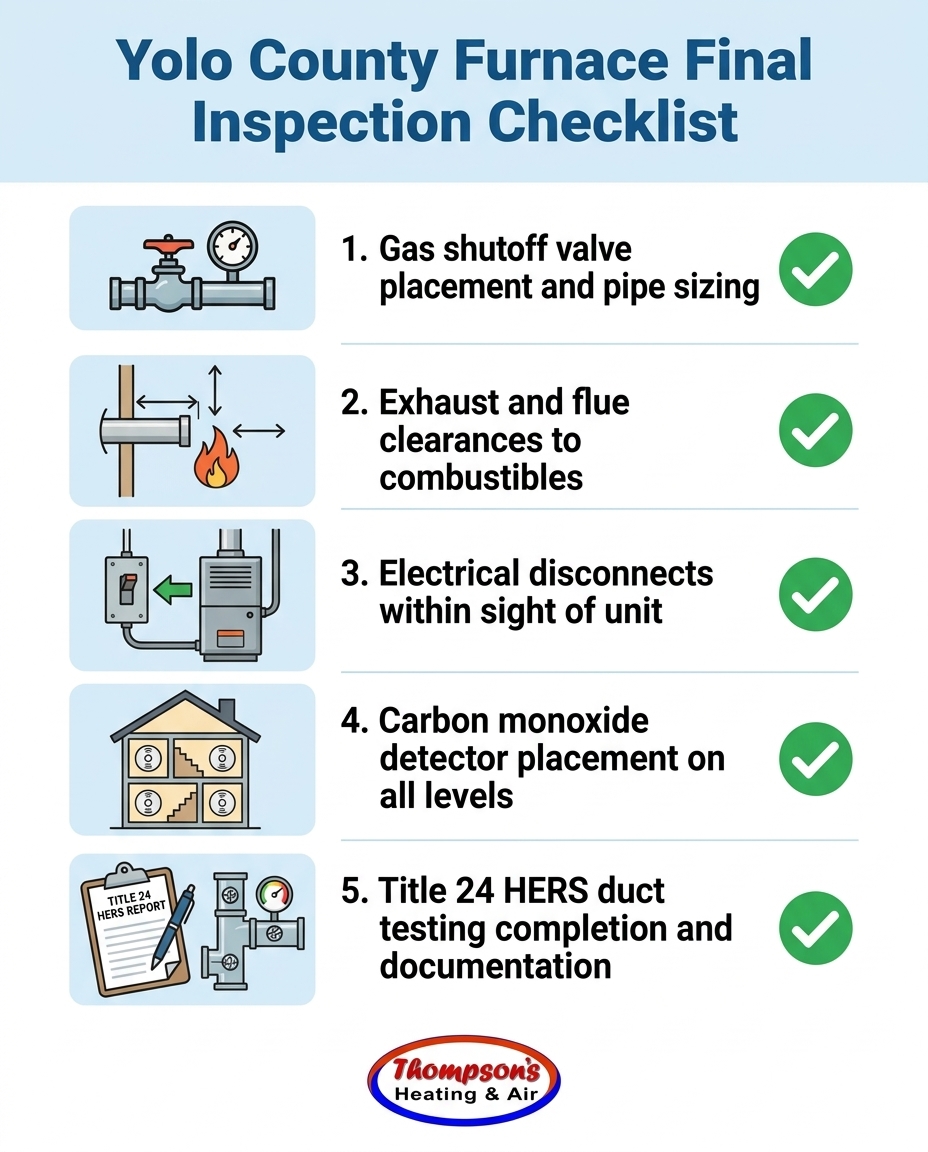
• Dedicated shutoff valves: Mechanical codes dictate that a dedicated gas shutoff valve must be installed within a very specific distance of the heating appliance (typically within six feet and in the same room). This allows for immediate fuel cutoff during an emergency or future servicing.
• Proper pipe sizing: The inspector verifies that the gas pipe is wide enough to deliver the correct volume of fuel. Undersized pipes cause the furnace to starve for fuel, leading to poor performance and premature component failure.
• Sediment traps (drip legs): These small, T-shaped pipe fittings catch moisture and debris in the gas line before it can enter the furnace's delicate gas valve. The inspector will confirm this trap is installed in the correct orientation.
Exhaust and Flue Clearances
Modern furnaces generate significant heat, and the exhaust gases must be safely routed out of the house. The inspector will carefully measure the distance between the hot exhaust pipes (the flue) and any combustible building materials, such as wood framing, drywall paper, or attic insulation.
Different efficiency ratings require different venting materials. An 80% AFUE furnace typically uses double-wall metal venting, which requires specific clearance margins to prevent radiant heat from starting a fire. Conversely, a high-efficiency 90%+ AFUE furnace uses PVC piping because the exhaust gases are much cooler, but the inspector will still verify that the PVC is properly sloped so acidic condensation drains safely away from the unit.
Navigating California Title 24 and HERS Testing Requirements
California has some of the most stringent energy efficiency standards in the country, governed by the Title 24 Building Energy Efficiency Standards. Whenever you alter a residential space conditioning system in most climate zones, the state requires proof that your ductwork is not leaking excessive amounts of conditioned air into unconditioned spaces like attics or crawlspaces.
This is where HERS (Home Energy Rating System) testing comes into play. You cannot pass your final Yolo County inspection without official HERS compliance documentation. The county inspector does not perform this test; it must be conducted by an independent, state-certified HERS rater.
What the HERS Rater Actually Does
Before the county inspector arrives, the HERS rater will visit your home to perform a duct leakage test. They will seal off all your supply and return registers and attach a calibrated fan to the system. By pressurizing the ductwork, they can precisely measure how much air escapes through loose joints, disconnected runs, or deteriorating materials.
If your ducts leak beyond the allowable threshold (typically 15% for alterations, though strict local codes may vary), the installing contractor must seal the ductwork until it passes. Once the system passes, the rater uploads the data to a state registry and generates a Certificate of Compliance. The Yolo County inspector will ask to see this specific paperwork during their visit.
Meeting these strict efficiency standards often opens the door to generic utility incentive programs. While you should always verify current offerings with your local utility provider, having a legally compliant, highly efficient system is the first step toward qualifying for programs like PG&E Insulation Rebates Woodland.
Electrical Connections and Carbon Monoxide Safety
While furnaces primarily run on natural gas, they require dedicated electrical circuits to power the blower motor, the ignition sequence, and the computerized control board. The Yolo County Building Inspector will evaluate these electrical connections just as rigorously as the gas lines.
One of the primary electrical requirements is a dedicated disconnect switch. Mechanical codes mandate that a clear, accessible electrical shutoff switch be installed within sight of the furnace. This ensures that any technician working on the system in the future can instantly cut the power, preventing accidental electrocution if someone else inside the house flips the main breaker back on.
Beyond the unit itself, the inspector will walk through your home to verify life-safety equipment. The California Building Code strictly mandates that carbon monoxide (CO) alarms must be installed in specific locations whenever a permit is pulled for a gas-burning appliance. Even if your new furnace is located out in the garage or up in the attic, the inspector will walk your interior hallways to check for these alarms.
Required Carbon Monoxide Alarm Locations:
• Outside of each separate sleeping area (typically in the hallway connecting bedrooms).
• On every level of the home, including basements.
• Installed according to the manufacturer's height specifications (usually knee-level or higher, as CO mixes evenly with indoor air).
If your home lacks functional carbon monoxide detectors in these required zones, the inspector will fail the final inspection, regardless of how perfectly the furnace itself was installed.
What Happens If a Furnace Installation Fails Inspection?
It is incredibly common for homeowners to feel a sense of dread at the word "fail." However, if your furnace installation does not pass the initial county inspection, it does not mean your system is ruined or that you made a terrible mistake. In the vast majority of cases, a failed inspection simply means a minor correction is required to meet the exact letter of the local code.
When an inspector finds an issue, they do not tear the system apart. Instead, they leave a formal correction notice. This document details the specific code violation—perhaps a gas sediment trap is facing the wrong direction, a flue clearance is off by half an inch, or a required carbon monoxide detector's battery was dead during the walkthrough.
The Correction Process Timeline
Once the correction notice is issued, the responsibility falls squarely on your installing contractor to make things right. A reputable company will handle this seamlessly.
1. Review the Notice: The contractor reviews the inspector's specific notes to understand what needs adjustment.
2. Perform the Correction: A technician returns to your home to make the necessary mechanical or electrical adjustments. This should always be done at no additional cost to the homeowner.
3. Schedule the Re-Inspection: The contractor contacts the county building department to schedule a follow-up visit.
4. Final Sign-Off: The inspector returns, verifies the specific correction was made, and signs off on the permit.
If you find yourself dealing with an aging system that hasn't been properly maintained or inspected in years, professional Heating Repair Woodland CA can help bring your equipment back to a safe baseline before a full replacement is necessary.
How a Local Expert Ensures a Stress-Free Sign-Off
The difference between a stressful inspection process and a smooth, effortless sign-off comes down to the contractor you choose. Experienced local installers do not wait for the inspector to tell them what to fix; they build to the local code from day one, anticipating the Yolo County checklist before the first wrench is ever turned.
Full-service contractors handle the entire bureaucratic burden for you. They pull the necessary permits, coordinate the independent HERS rater for your Title 24 duct testing, and schedule the final county inspection at a time that works for your family. This comprehensive approach ensures that you aren't left trying to decipher municipal building codes on your own.
Working with Thompson's Heating & Air means benefiting from deep familiarity with Yolo County building codes and Title 24 requirements, which ensures every furnace replacement is installed correctly the first time, avoiding frustrating delays. We know how important it is to have a reliable system ready for move-in or seasonal shifts. For example, one customer recently needed a complete HVAC system setup in a new home before moving in; our crew completed the rigorous installation while they were away, leaving the home completely clean, fully compliant, and perfectly comfortable for their arrival.
That is the peace of mind that comes from hiring true local experts. You aren't just buying a box that produces heat; you are investing in a safe, officially verified mechanical system that will protect your family for years to come.
Finalize Your Winter Comfort with Confidence
Passing the final inspection is the ultimate reassurance that your home is safe, efficient, and fully prepared for the dropping temperatures. By understanding the critical checks—from gas line integrity and exhaust clearances to Title 24 HERS testing and carbon monoxide safety—you can approach the September pre-heating season without anxiety.
Don't let the fear of municipal red tape keep you from upgrading an unsafe or failing heating system. Rely on local professionals who navigate the permitting and inspection process seamlessly on your behalf. If you are ready for an expert installation that guarantees compliance and total peace of mind, reach out to our team today to secure your winter comfort.
Frequently Asked Questions
What happens if my HVAC installation fails inspection in Yolo County?
If your installation fails, the inspector will issue a correction notice detailing the specific code violation. Your installing contractor is responsible for returning to your home, making the necessary adjustments at no additional cost, and scheduling a re-inspection. A failed inspection is usually a minor hurdle, not a major disaster, ensuring your system is ultimately perfectly safe.
Do I need a permit to replace a furnace in California?
Yes, replacing a furnace requires a building permit in California. Because the process involves altering combustible gas lines, high-voltage electrical circuits, and exhaust venting, local jurisdictions mandate a permit to ensure the work meets all current safety and mechanical codes. Unpermitted work can lead to safety hazards, insurance issues, and complications when selling your home.
What does a mechanical inspector look for on a new furnace?
A mechanical inspector focuses heavily on safety and efficiency standards. They will check the integrity of the gas line connections, verify proper clearances around the hot exhaust flue, and ensure a dedicated electrical disconnect switch is installed. They also confirm that carbon monoxide detectors are properly placed throughout the home and review the required Title 24 energy efficiency paperwork.
Is HERS testing required for a furnace replacement in California?
In most California climate zones, HERS (Home Energy Rating System) testing is mandatory when replacing a furnace or altering ductwork. An independent rater must test your duct system for air leakage to ensure it meets the strict energy efficiency standards outlined in Title 24. The county inspector will require the official Certificate of Compliance before granting final permit approval.
How long does a final furnace inspection take?
A typical final furnace inspection usually takes between 15 and 30 minutes, provided the installation is clean and accessible. The inspector will quickly verify the equipment matches the permit, check the critical safety components (gas, venting, electrical), walk the home to check for carbon monoxide alarms, and review the HERS testing paperwork. If everything is in order, they will sign off on the spot.
Who is responsible for scheduling the final county inspection?
A reputable, full-service HVAC contractor will handle the scheduling of the final county inspection on your behalf. They will coordinate with the local building department and find a time window that accommodates your schedule. While the homeowner usually needs to be present to let the inspector inside, the contractor manages all the underlying paperwork and coordination.



.avif)
.avif)
.png)
