
Planning Your HVAC Replacement Timeline Before the Fall Rush Begins

Surviving the Final Heat Waves: Why Timing Your Upgrade Matters
Planning your HVAC replacement timeline before the fall rush begins is the smartest move you can make when nursing an aging, failing AC through the final intense heat waves of late August. Here in Woodland, CA, and the surrounding Central Valley, our team at Thompson's Heating & Air knows firsthand that late summer brings a very specific kind of stress. The days remain blisteringly hot, forcing older air conditioners to run nonstop just to maintain a baseline level of comfort. Every time the compressor kicks on with a loud groan, you find yourself holding your breath, wondering if this is the day the system finally quits for good.
The primary decision you face right now is whether to proactively schedule an upgrade or wait for a total system failure when the heating season begins. Waiting puts you at the mercy of emergency schedules and limited equipment availability. Acting now ensures you have better scheduling flexibility, more time to choose the right system, and total control over your home's comfort transition. If you are tired of crossing your fingers every time the thermostat clicks on, modern Air Conditioning technology offers superior reliability and efficiency.
Common signs our technicians see when an AC is struggling through its final season:
• Constant running: The unit never cycles off, yet the house still feels warm and humid.
• Strange noises: Grinding, squealing, or rattling sounds indicate failing internal components.
• Rising energy bills: You are paying significantly more for the same amount of cooling compared to last summer.
• Frequent repairs: You have already called a technician out more than once this season to keep the system limping along.
The climate in the Central Valley is notoriously unforgiving. We experience lingering, intense heat well into August and September, which rapidly drops to chilly overnight temperatures in late fall. Taking control of your replacement timeline now guarantees you are prepared for both extremes.
The Strategic Advantage of the Late-Summer Sweet Spot
There is a narrow window of opportunity that our industry professionals consider the ideal time for system upgrades. This late-summer "sweet spot" typically aligns with the late August back-to-school transition. During this period, the peak emergency cooling calls we receive begin to taper off slightly, but the frantic rush for winter heating repairs has not yet begun. Tackling home improvement projects during this transitional phase is the perfect way to get your home in order before the chaos of the holiday season takes over.
Avoiding the peak heating season rush is critical because it prevents you from having to settle. When a furnace dies on the first freezing night of November, homeowners often have to accept whatever equipment is immediately available in the warehouse, rather than selecting the optimal unit for their specific needs. Proactive planning eliminates this forced compromise. For example, during a recent late-summer heat wave, our dispatchers received a frantic call from a local property owner when their tenant's AC failed completely in the middle of a dangerously hot week. While our service team was able to respond quickly and resolve the issue despite a packed schedule, emergency situations like this are highly stressful and are exactly what proactive planning helps you avoid.
Scheduling your AC replacement in Woodland during this late-summer window provides incredible peace of mind. You rest easy knowing your home is fully prepared to handle any unexpected late-season heat waves, while simultaneously being ready for that inevitable first cold snap of autumn.
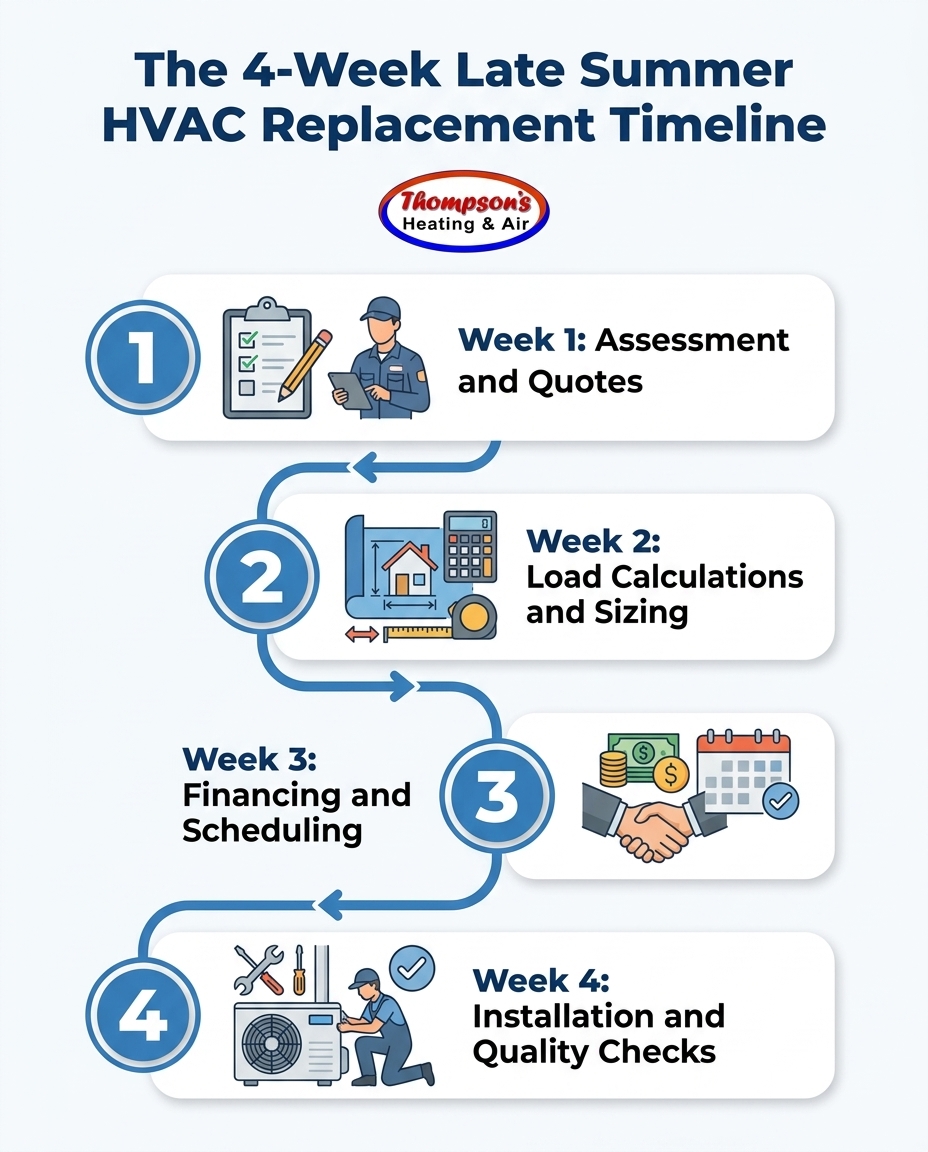
Week 1: Evaluating Your Current System and Gathering Quotes
The first week of your replacement timeline is entirely focused on assessment and initial professional consultations. This is the information-gathering phase, where you determine exactly what your home needs and what options are available on the market.
The first step is identifying the definitive signs that your system is truly beyond simple, cost-effective repairs. In our years of serving Woodland homeowners, we've found that if your central air conditioner is between 10 and 15 years old, uses outdated R-22 refrigerant, and requires frequent interventions just to maintain a basic level of cooling, investing in a new system is far more practical than pouring money into a failing unit. If you are currently deciding whether to repair or replace your HVAC, we consistently advise that age and repair frequency are your two biggest indicators.
Step-by-Step Guide to Week 1:
1. Schedule consultations immediately: Book your initial home assessments before local technicians are completely booked solid with early fall maintenance visits.
2. Prepare your questions: Make a list of your current comfort issues, such as hot spots in certain rooms or excessive indoor humidity.
3. Expect a thorough inspection: A qualified professional will not just look at the outdoor unit; they will inspect your ductwork, check your insulation levels, and evaluate your home's overall thermal envelope.
4. Review your options: Gather all necessary information, including equipment tiers, efficiency ratings (SEER2 and AFUE), and warranty terms, so you can make an informed, unhurried decision.
Repair vs. Replacement: Making the Call
• Under 10 years old, minor electrical issue — Likely Recommendation: Repair — Reasoning: The system still has a majority of its expected lifespan remaining.
• Over 12 years old, major compressor failure — Likely Recommendation: Replace — Reasoning: The cost of a new compressor outweighs the value of the aging system.
• Frequent breakdowns, rising energy bills — Likely Recommendation: Replace — Reasoning: Efficiency has permanently degraded, costing you money every month.
• Clogged drain line, dirty condenser coils — Likely Recommendation: Repair / Maintenance — Reasoning: These are standard upkeep tasks that do not indicate systemic failure.
Week 2: The Critical Role of Proper Sizing and Load Calculations
Once you have gathered your quotes and selected a path forward, Week 2 is dedicated to the technical planning phase. This is arguably the most important step in the entire process, and rushing it is the leading cause of poor long-term HVAC performance.
Before any equipment is ordered, a professional installer must perform a Manual J load calculation. This is a detailed mathematical assessment that determines exactly how much heating and cooling capacity your specific home requires. It takes into account your home's square footage, window placement, ceiling height, insulation quality, and local climate data. It is a meticulous process that simply takes time to perform correctly.
The Dangers of Guesswork
Skipping the load calculation and simply replacing your old unit with one of the exact same size is a massive risk that we unfortunately see far too often in Central Valley homes. Homes change over time—you may have upgraded your windows, added insulation, or built an addition. Installing an improperly sized unit leads to severe consequences:
• Oversized units: A unit that is too large will "short-cycle," meaning it turns on and off rapidly. This fails to remove indoor humidity, leaves the house feeling clammy, and puts immense wear and tear on the compressor, drastically reducing its lifespan.
• Undersized units: A unit that is too small will run continuously, struggling to reach the set temperature. This drives up your utility bills and leads to premature mechanical failure due to constant overworking.
This is where proactive planning truly pays off. A meticulously planned installation guarantees that the sizing is calculated, not guessed. At Thompson's Heating & Air, we are committed to proper sizing and meticulous installation over rushing jobs—this is a core standard our technicians uphold on every project. When you book in the late summer, you guarantee your installation team has the time required to perform these essential calculations without the pressure of a backlog of freezing, desperate customers waiting for emergency service.
Week 3: Finalizing Upgrades, Incentives, and Payment Options
With the technical specifications locked in, Week 3 is all about guiding you through the financial and administrative steps of the replacement process. Upgrading your home's climate control is a significant investment, but proactive planning gives you the breathing room to explore every available financial advantage.
Modern, high-efficiency heat pumps and air conditioning systems often qualify for various generic federal tax credits and local utility rebates. Because energy efficiency is a major priority for utility providers, taking the time to research these incentives can make premium equipment much more accessible. Our team always advises readers to verify all current incentive qualifications, program rules, and availability directly with their utility provider or a qualified tax professional, as these programs frequently update their requirements.
Your Week 3 Planning Checklist:
• Explore financing options: Securing HVAC financing early streamlines the scheduling process, removes last-minute stress, and allows you to choose a comfortable monthly payment plan.
• Review generic rebates: Check your local utility company's website for available energy-efficiency programs for high-SEER2 equipment.
• Confirm the installation date: Lock in your day on the calendar before the schedule fills up with early fall maintenance requests.
• Prepare the workspace: Clear the areas around your indoor furnace or air handler, ensure clear access to the outdoor compressor, and move any vehicles out of the driveway to make room for the installation trucks.
• Make arrangements for pets: Plan to keep dogs and cats secured in a separate room on installation day so the crew can move safely in and out of the house.
By checking off these administrative tasks during Week 3, you ensure that installation day goes off without a hitch.
Week 4: Installation Day and Transitioning to Reliable Heating
The culmination of your 4-week timeline is installation day. Because you planned ahead, this day should be exciting rather than stressful. You know exactly what equipment is arriving, you know it is sized perfectly for your home, and you know your finances are fully organized.
A professional installation begins with the crew arriving on time and immediately focusing on property protection. Our technicians will lay down drop cloths, wear floor savers, and carefully remove your old equipment. The actual installation of a dual-system replacement (both AC and furnace) or a modern heat pump typically takes a full day. This comprehensive upgrade ensures your home is immediately ready for whatever fall weather arrives.
The Post-Installation Process
The job is not finished simply because the new equipment is bolted into place. A meticulous installation requires comprehensive system testing. The technicians will check the refrigerant charge, measure airflow, test the thermostat calibration, and ensure all safety sensors are functioning correctly.
When one local homeowner recently scheduled their installation with us, our crew's focus was entirely on doing the job right from start to finish. The technicians performed a thorough installation, followed by a comprehensive post-installation walkthrough, leaving the customer thoroughly impressed with the reliability and quality of the work. This is the standard you should expect from your contractor.
During your final walkthrough, the lead technician will show you how to operate your new thermostat, explain the recommended filter replacement schedule, and answer any final questions. Securing your heating installation before the cold weather hits means you can simply turn on the heat the moment that first chilly autumn evening arrives, confident that your system will perform flawlessly.
The Hidden Costs of Waiting for an Emergency Breakdown
To truly understand the value of this 4-week proactive timeline, it helps to look at the alternative. Having responded to countless late-night emergency calls across the Sacramento Valley over the years, our team knows firsthand that waiting for an emergency breakdown carries hidden costs that go far beyond the price of the equipment itself.
The Sacramento Valley is known for its sudden climate shifts. We frequently transition from intense late-summer heat directly into sudden fall cold snaps. If you wait until that first freezing night to turn on an aging furnace, only to discover it has failed, you are suddenly thrust into a chaotic reality. You are now competing with dozens of other homeowners who are experiencing the exact same emergency.
The risks of emergency replacements include:
• Extended wait times: When technicians are flooded with emergency heating calls, you may have to wait days for an initial assessment, leaving your family in a freezing house.
• Limited equipment choices: Supply houses run low on specific models during peak demand. You may have to settle for a unit that is less efficient or lacks the features you want simply because it is the only one in stock.
• Rushed decisions: You lose the ability to carefully compare quotes, secure favorable financing, or research available energy rebates.
By committing to a proactive timeline in late August, you eliminate these risks entirely. You take control of the process, secure the best possible equipment for your home, and guarantee a meticulous, unhurried installation. Planning your HVAC replacement timeline before the fall rush begins is the ultimate way to ensure year-round comfort, lower energy bills, and total peace of mind for your family.
Frequently Asked Questions
How long does the HVAC replacement process take?
The actual physical installation of a new HVAC system typically takes one to two full days, depending on the complexity of the job. However, the entire planning process—from initial assessment to final installation—usually spans about three to four weeks. Proactive planning ensures there is ample time for load calculations, securing financing, and ordering the exact equipment your home needs.
When should I schedule my fall HVAC installation?
We recommend scheduling a fall installation during the late August to early September "sweet spot." During this transitional period, summer emergency calls are slowing down, and the winter heating rush has not yet begun. Booking during this window guarantees you the most flexibility in choosing your installation date.
Why is HVAC sizing important before installation?
Proper sizing ensures your new system operates at peak efficiency and maintains a long lifespan. If a unit is too large, it will short-cycle and fail to remove humidity; if it is too small, it will run constantly and drive up your energy bills. A professional Manual J load calculation takes the guesswork out of this critical step.
What is the best month to buy an HVAC system?
Late August, September, and early spring (March or April) are generally considered the best months to purchase new equipment. These off-peak shoulder seasons allow you to avoid the frantic scheduling rushes of mid-summer and mid-winter. Installers have more time to dedicate to meticulous planning and load calculations during these months.
Can I replace my AC and furnace at the same time?
Yes, replacing both the air conditioning and heating components simultaneously is highly recommended if both units are aging. A dual-system replacement ensures that the indoor air handler and outdoor condenser are perfectly matched for optimal efficiency. It also saves you money on long-term labor costs compared to replacing the units years apart.
How far in advance should I start planning my HVAC upgrade?
You should start gathering quotes and researching options at least three to four weeks before you want the installation completed. This timeline gives you a week to gather estimates, a week for technical sizing, a week to secure financing and rebates, and a final week for the actual installation day.



.avif)
.avif)
.png)
